.svg)

AI-Native MDM: 5 Considerations When Debating Build vs. Buy

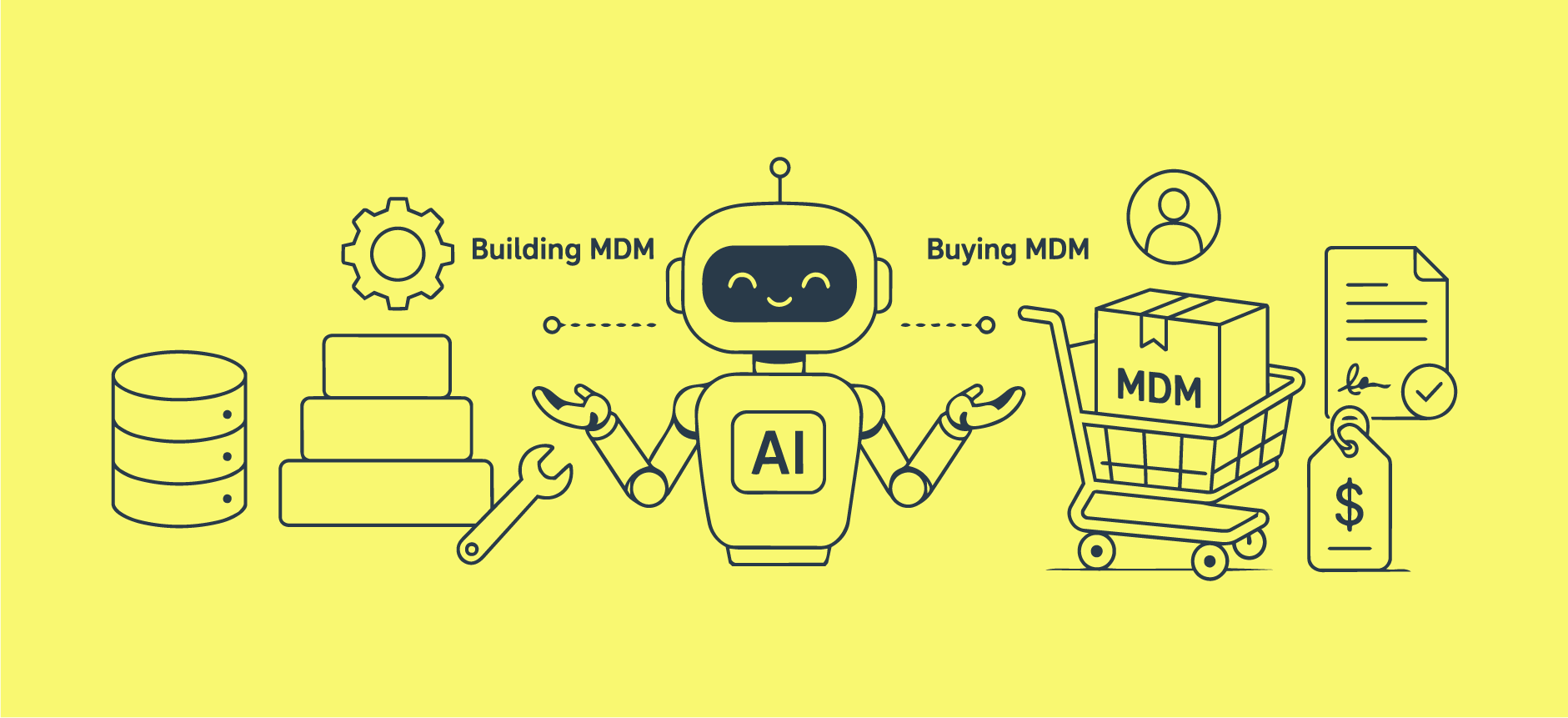
Generative AI and coding assistants like Claude Code, OpenAI Codex, and GitHub Copilot have made software development faster and more accessible than ever before, prompting many organizations to revisit “build vs. buy” decisions. However, today, the more important question is what to build and what to buy.
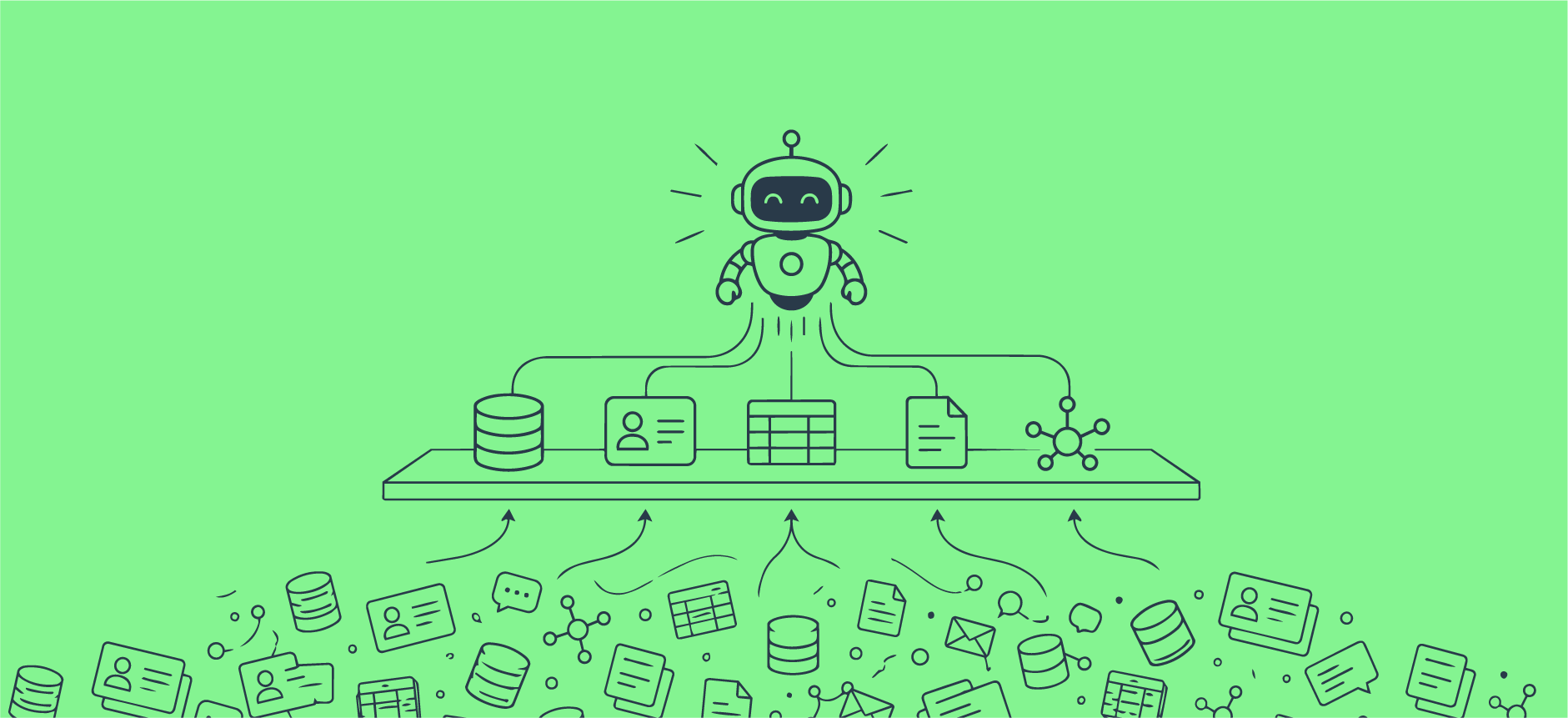
While AI can accelerate software development, it doesn’t eliminate the complexity of reliably mastering data at scale. Organizations must still address challenges such as entity resolution, data quality, governance, scalability, and long-term maintenance. At the same time, AI creates new opportunities to build business-specific applications, workflows, and agents that leverage trusted master data.
For most organizations, the greatest value comes not from rebuilding foundational technologies, but from applying engineering resources to the processes, workflows, and experiences that are unique to the business. As our CEO and I discuss in this on-demand webinar, the build-versus-buy decision for master data management (MDM) is more nuanced than it first appears. So, before deciding whether to build, buy, or combine the two approaches, consider the following five factors:
1. Scalability
DIY methods can deliver benefits for organizations looking to resolve entities across a single source or relatively small datasets. Yet, as data volume and complexity grow, scalability quickly becomes an issue. While a script running on a server or a basic application may work for a limited subset of records, an internally built approach will reach its limit well before it can support the full breadth of organizational data, and will likely break down as the data changes and evolves over time and as you add more sources to the mix.
2. Entity Resolution Complexity
Generative AI can quickly produce code that compares records and identifies potential matches. However, enterprise-scale entity resolution is far more complex. As data volumes grow, matching approaches that work well on small datasets often become computationally expensive and operationally impractical. Organizations must account for duplicate detection, clustering, survivorship rules, false positives, false negatives, and performance optimization at scale. While AI can help generate code, it cannot eliminate the underlying complexity of entity resolution itself. Errors in this area can lead to fragmented profiles, undetected duplicates, inaccurate analytics, and reduced trust in the enterprise data.
3. Security
Security is another key consideration for companies that deploy DIY MDM solutions. Not only must the internally developed solution ensure the protection of sensitive data for compliance purposes, but it must also establish the appropriate governance and controls to protect secure information from unauthorized access and use. The more users you have, the greater the need for robust security and governance protocols, which quickly adds complexity to your in-house development efforts.
4. Hidden Costs
While DIY MDM may appear more cost-effective on the surface, it’s important to consider the cost of updating and maintaining the solution over time. From infrastructure to additional resources and support, what initially begins as an affordable approach can quickly become quite expensive to maintain as your in-house solution is put into production. Organizations using AI coding assistants should also account for ongoing AI-related expenses. Custom-built applications require continuous maintenance, dependency upgrades, security patching, testing, and architectural updates. Teams increasingly rely on AI tools to perform this work, introducing recurring token consumption and operational costs that continue long after the initial build is complete. Beyond the direct costs, organizations must also consider the opportunity cost of diverting valuable resources to the ongoing build, maintenance, and governance of the DIY platform.
5. Skills Gap
Building and maintaining a DIY MDM tool requires specific skills and expertise. The solution will inevitably become more complex over time, and so, too, will the skills required to evolve and maintain it. As you evaluate whether a custom-build approach is right for your organization, it’s important to weigh the existing in-house expertise against the specialized skills needed not only to build—but also to sustain and evolve—the solution over time. For example, does your existing engineering team have the advanced AI skills needed to develop the matching, linking, and enrichment, and governance capabilities of an enterprise-class MDM solution? And what happens when staff with intimate knowledge of your home-grown solution leave your organization?
An AI-Native Approach to MDM
We’ve all heard the saying “just because you can, doesn’t mean you should.” And in the context of data mastering, this adage definitely rings true. DIY MDM can be appropriate in select, small-scale situations, but the bigger question remains: Is it worth the effort and the risk?
Companies that want to implement data mastering at scale are better off exploring a commercially proven solution like Tamr. Tamr uses a layered approach of advanced fit-for-purpose AI/ML models, agentic data curation, and smart rules to master data at scale—without the hassles and costs of building and maintaining a solution in-house.
Tamr’s AI-native MDM provides feature-rich platform capabilities out-of-the-box that would be extremely difficult to incorporate effectively within a home-grown solution. With Tamr, organizations can realize numerous benefits in days or weeks, not months or years, such as:
- Faster time-to-value: Onboard new internal and external data sources quickly and easily to realize value faster.
- Greater scalability: Handle the largest volumes of data possible using cloud-based technology, optimized for scalability.
- AI-first approach: Free up technical resources and increase automation using patented machine learning capabilities and agentic AI functionality that improve as data grows and evolves.
- Improved accuracy: Employ probabilistic matching and automated entity resolution to improve data quality and minimize manual effort.
- Increased flexibility: Support analytical and operational use cases in different ways, and easily adjust as needs evolve.
- Predictable costs: Maintain clear visibility of the costs associated with operating and scaling the solution.
- Continuous innovation: Take advantage of ongoing enhancements driven by customer feedback, industry research, and strategic product development.
So What Should You Build?
Rather than investing resources in recreating core MDM functionality, organizations often realize greater value by building the business-specific workflows that sit on top of trusted master data. Examples include:
- AI-powered territory assignment
- Customer routing and prioritization
- Agentic business workflows
- Industry-specific applications
These are the areas where organizations possess unique expertise and where custom development can create a meaningful competitive advantage. In this model, purpose-built MDM platforms provide the trusted data foundation, while internal development teams focus on the workflows, applications, and experiences that make the business unique.
Why Build When You Can Buy Tamr?
As modern business and data continue to evolve and expand, Tamr’s AI-native MDM can serve as a critical platform for delivering master data reliably and at scale. Using Tamr, organizations can quickly and easily resolve entities across domains; create unified profiles for key business entities; establish a trusted data foundation that supports real-time personalization; improve customer engagement and conversion; and support analytical, operational, and AI use cases—fueling business growth now and into the future.
Want to learn more? Watch our on-demand webinar, 5 Key Factors to Consider in the MDM Solution “Build vs. Buy” Debate.
Get a free, no-obligation 30-minute demo of Tamr.
Discover how our AI-native MDM solution can help you master your data with ease!