.svg)

What is Master Data Management (MDM)?


Editor’s Note: This post was originally published in March 2022. We’ve updated the content to reflect the latest information and best practices so you can stay up to date with the most relevant insights on the topic.
For decades, organizations have been managing fragmented views of data across multiple, disparate systems and silos. But as data grows increasingly larger and more complex, the need for a unified foundation of trustworthy data is even greater. That’s why master data management (MDM) has become a core data management discipline for organizations worldwide.
What is Master Data Management (MDM)?
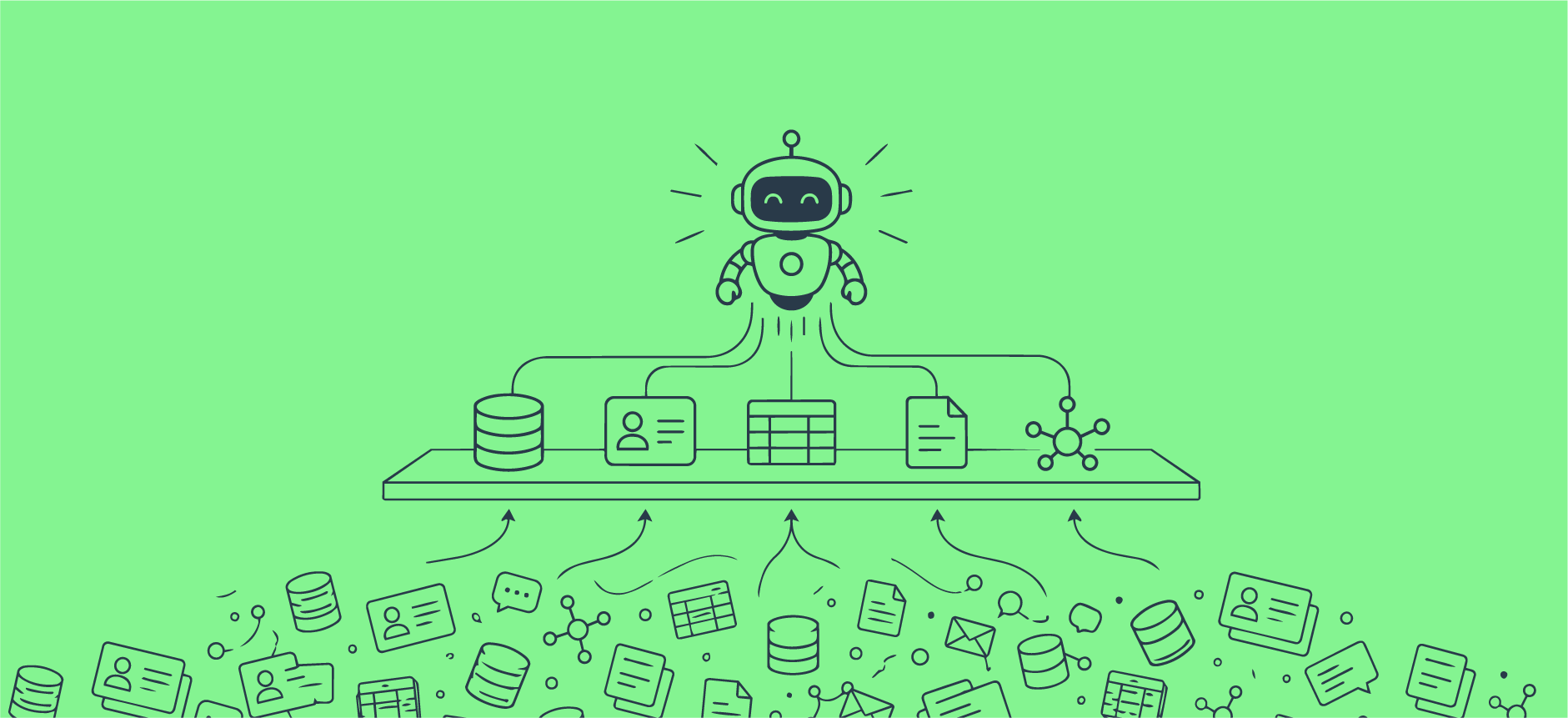
Master data management is a data management practice that aims to create a trustworthy, single source of truth for critical enterprise data. Using MDM, organizations unify data about their key business entities (e.g., customers, suppliers, products, etc.) across sources to create clean, curated, enriched 360-degree views to support analytics, operations, and AI initiatives.
Why Do Businesses Use MDM?
Many businesses are looking for ways to deliver more accurate analytics, deeper insights, and greater operational efficiencies by better leveraging data that is spread across numerous sources and systems. They also want to ensure they’re feeding AI systems the best, most trustworthy version of their data. To do this, organizations need to consolidate, cleanse, and standardize datasets from internal data sources such as their CRM, ERP, CDP, and other business-critical systems, as well as external data from trustworthy, third-party sources. That’s where MDM comes in.
Organizations have been using MDM for decades to ensure that everyone across the organization has a single, authoritative version of the truth—a golden record. These curated, deduplicated, and enriched golden records are imperative for organizations that wish to leverage their data assets with accuracy, confidence, and impact.
MDM Use Case: Customer 360
One popular MDM use case is Customer 360, a mastering process that unifies disconnected customer data across CRMs, ERPs, CDPs, marketing automation platforms, support systems, and more to deliver a 360-degree view of each customer. This consolidated customer view is valuable to teams across the organization, from sales and marketing to finance and customer service.
Businesses use mastered B2B and B2C customer data to answer many important questions such as:
- Who are our customers—and how can we better engage them?
- Are we serving the same customers from different business units?
- Which products are our most popular and profitable?
- How can we get a holistic view of service consumption for more informed decisions?
Businesses might also want to know:
- How can we reduce support costs?
- How can we enable smarter reporting, better analytics, and improved operational performance?
- How can we ensure that AI-generated customer insights are accurate and trustworthy?
Having answers to these questions is critical across a range of industries, from retail and manufacturing to financial services and the public sector. Meanwhile, the downside of not having mastered data is significant. Most organizations recognize the symptoms of poor master data in their critical business processes, whether it’s delayed product launches, high supply chain costs, frequent customer complaints, or hefty regulatory penalties.
What Are the Limitations of Legacy Master Data Management Solutions?
One of the biggest challenges with a traditional, rules-based MDM solution is its inability to scale in today’s complex, increasingly expanding data environments. Data mastering involves producing clusters of records thought to represent the same entity. Once the MDM solution creates the clusters, the next step is to construct a single golden record for each cluster. This involves finding matches. And the traditional master data management approach to finding matches is to use rules.
This rules-based approach used by traditional MDM solutions quickly becomes a liability. When organizations are dependent on rules-based engines, they need teams of data experts, developers, and business teams to collaborate on coding complex formulas that capture constantly changing business logic. Whenever new datasets or data updates are introduced to the solution, long cycles of iterations are needed among IT, data, and business teams to refine the MDM rules logic. It’s time-consuming and resource-intensive. And it doesn’t scale well as data continues to grow and evolve.
Four Key Features of AI-Native MDM
AI-native MDM solutions like Tamr combine machine learning, AI agents, and human feedback to unify, clean, and enrich data across silos and sources in order to create accurate, complete, and continuously maintained golden records. And they offer numerous benefits that traditional, rules-based solutions simply can’t deliver.
1. Built with AI at the core
From the architecture to workflows to user interfaces, AI-native MDM is built from the ground up with AI at the core. This AI-native approach, pioneered by Tamr, outperforms legacy, rules-based methods because it delivers faster access to clean, curated, trusted data with less manual effort, which provides a strong foundation for analytics, operations, and AI initiatives.
An AI-native solution is different from other MDM solutions that simply bolt AI on top of their existing architecture to deliver capabilities like automation, recommendations, or predictive analytics. Because AI is added on as an afterthought—not embedded at the core—these AI-enhanced solutions introduce complexity and limitations when it comes to performance, scale, and user experience.
2. Powerful modern architecture
AI-native MDM solutions combine advanced AI/ML, agentic data curation, and select, smart rules to handle more than 95% of the work needed to master data at scale. By unifying, cleaning, and enriching data across systems and sources, AI-native MDM solutions like Tamr deliver the trustworthy golden records organizations need to drive better business outcomes.
In addition, unlike rules-based MDM solutions, AI-native MDM is built for scale. Using an event-driven, API-first architecture, an AI-native MDM solution like Tamr easily integrates with other platforms and supports agentic AI workflows and “bring-your-own-agent” models.
3. Fit-for-purpose AI/ML models
Every AI/ML model utilized in AI-native MDM serves its own, distinct purpose. For example, rules-based systems use straightforward “if/then/else” structures to match and resolve business entities. And while they may seem simple, these rules-based systems—used by traditional MDM solutions—quickly become unwieldy to maintain or troubleshoot, making them ineffective for the demands of modern data.
AI-native MDM solutions, on the other hand, combine machine learning, deep learning, and LLM-based agents, allowing them to employ the right AI/ML model at the right time to handle each part of the mastering process. This approach, used by Tamr, masters far more of the data than rules-based systems, including the “last mile”—the last 5% or so of data that remains unresolved after the mastering process—with minimal human intervention.
4. SaaS-based architecture
AI-native MDM solutions like Tamr are SaaS-based, offering a host of benefits such as lower upfront costs, faster time-to-value, greater flexibility, and built-in scalability. SaaS-based solutions scale automatically to meet your needs, delivering the consistent performance and capacity needed to support the business as needs evolve. And, they are quick to deploy, delivering value in days or weeks—not months or years.
Traditional, rules-based MDM solutions struggle to deliver the speed and savings that AI-native MDM provides. Not only are their operational costs higher, but they also require larger teams to support their infrastructure and require more time to see results.
Tamr’s AI-Native MDM Solution
Tamr is the AI-native MDM standard. With 19 patents behind the technology, Tamr has spent more than a decade focused on using AI and machine learning to solve the hard problem of mastering enterprise data at scale. Everything Tamr delivers—from architecture and workflows to user interfaces and platform capabilities—is built around AI. Using Tamr’s AI-native MDM, organizations can create trustworthy golden records for use in analytics, operations, and AI initiatives.
Get a free, no-obligation 30-minute demo of Tamr.
Discover how our AI-native MDM solution can help you master your data with ease!