

AI agents are only as effective as the data they can access. But for many organizations, fragments, inconsistent, and sensitive data can make it difficult to build the trust needed for AI to deliver reliable results.
In this on-demand webinar, Jarret Garcia, Director of Enterprise Platform Architecture at Iron Mountain, joins Tamr CEO Anthony Deighton to explore how trusted, governed data can provide the foundation for successful agentic AI workflows.
Hear how Iron Mountain is using AI-native MDM to strengthen its data foundation, improve confidence in its data, and give AI agents the right access to the information they need – without compromising sensitive data. The conversation also explores how data leaders can address quality challenges and begin preparing their data for AI, even when it isn’t perfect.
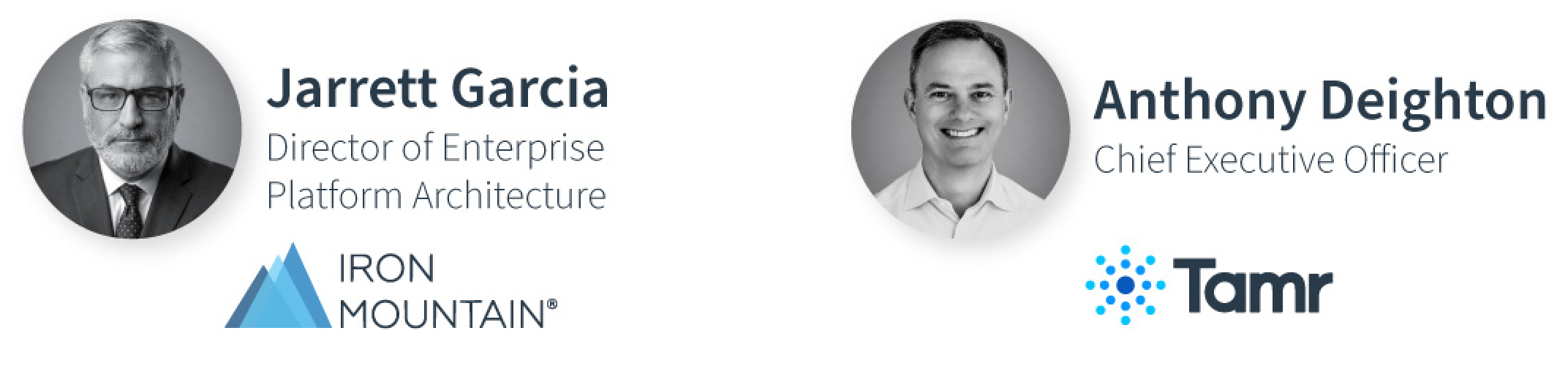
Learn from our expert speakers:
What you’ll take away:
- Learn how Iron Mountain is using Tamr’s AI-native MDM to create a trusted data foundation for agentic AI workflows
- Explore how Iron Mountain gives AI agents the right level of data access while protecting sensitive information
- Understand how data quality issues can impact AI reliability – and what organizations can do to address them
- Get practical guidance for preparing your data for AI, even when your data environment isn’t perfect
Whether you’re exploring AI agents, modernizing your MDM strategy, or looking for practical ways to build greater trust in enterprise data, this session offers a real-world perspective on creating the data foundation AI needs to succeed.

AI agents are only as effective as the data they can access. But for many organizations, fragments, inconsistent, and sensitive data can make it difficult to build the trust needed for AI to deliver reliable results.
In this on-demand webinar, Jarret Garcia, Director of Enterprise Platform Architecture at Iron Mountain, joins Tamr CEO Anthony Deighton to explore how trusted, governed data can provide the foundation for successful agentic AI workflows.
Hear how Iron Mountain is using AI-native MDM to strengthen its data foundation, improve confidence in its data, and give AI agents the right access to the information they need – without compromising sensitive data. The conversation also explores how data leaders can address quality challenges and begin preparing their data for AI, even when it isn’t perfect.
Learn from our expert speakers:
What you’ll take away:
- Learn how Iron Mountain is using Tamr’s AI-native MDM to create a trusted data foundation for agentic AI workflows
- Explore how Iron Mountain gives AI agents the right level of data access while protecting sensitive information
- Understand how data quality issues can impact AI reliability – and what organizations can do to address them
- Get practical guidance for preparing your data for AI, even when your data environment isn’t perfect
Whether you’re exploring AI agents, modernizing your MDM strategy, or looking for practical ways to build greater trust in enterprise data, this session offers a real-world perspective on creating the data foundation AI needs to succeed.
Watch Webinar!

Want to read the transcript? Dive right in.
Speaker 1
Alright. Can everyone hear us? Good morning, good afternoon, or good evening, everyone. Thank you so much for joining today's session, the basis for AI success, how Iron Mountain built confidence in its data to fuel agentic workflows. Before we begin, I'd like to cover a few housekeeping items.
Let me switch to the other slide. There we go. So many production windows.
Closed captioning is available. Simply hover over the virtual stage and click the CC button located at the bottom of your screen. We encourage you also to submit your questions leveraging the q and a tab in the engagement panel on your right.
We'll do our best to answer questions at the end of the presentation. And if we are unable to get your get to your question, we'll follow-up with you directly.
We've also added some additional resources, which are available in the docs tab in the engagement panel on your right. There, you can find some additional related content. And today's webinar will be available on demand after we wrap up. It will be sent to you via email directly. Today, we are joined by two leaders who bring deep expertise in enterprise management and AI. Kicking us off is Tamer's chief executive officer, Anthony Dayton, and alongside him is Jarrett Garcia, Iron Mountain's director of enterprise platform architecture.
We're delighted to have them both with us today, and I'm going to welcome and toss everything over to Anthony.
Speaker 2
Great. Thanks so much, Kara, and thank you to Jared for joining us as well.
Just by a brief introduction for me, obviously, I'm the CEO here at Tamr. I have a long background in history and data and analytics. And what sort of drew me to Tamr and to the opportunity here is really this idea really basic idea that the quality of enterprise data is what's really inhibiting organizations from taking advantage of that data in terms of AI workloads. And that's really the focus of today's webinar, so I think it'll be really fun and exciting. So but, Jarrett, maybe introduce yourself.
Speaker 3
Sure. Thanks, Anthony. My name is Jarrett Garcia. I've been with Iron Mountain for about eight years. In that time, we we I was brought on to build an enterprise data platform. And as part of that, you know, we've begun our, master data, program, and, we've been engaged with Tamer for the past years in helping us to achieve that.
Speaker 2
Awesome. So, maybe to start, Jared, I think it would be helpful for folks just to ground the conversation. If they understood a bit better who Iron Mountain is, I would venture to guess that many listeners on the webinar are Iron Mountain customers. Yeah. But even sometimes without realizing it in in many cases. And I think it's also fair to say that the product breadth that Iron Mountain offers is much wider than people necessarily imagine. So maybe start us off with just a little grounding on on Iron Mountain.
Speaker 3
Sure. Well, again, it we've been around for about seventy five years. We've been celebrating that this year.
And, again, we're primarily known for our records and data management storage. So you'll see the trucks driving around globally with, you know, the Iron Mountain logo where we're picking up boxes of papers and storing them and but we've grown to be a lot more than just that.
We are we have, of course, a digitalization specialist. So if you wanna be able to digitize your documents, we offer services for that.
And then two other big areas that we do is asset life cycle management. And so that's taking all of the leftover or unwanted technologies and working on recycling those. And then I'm actually in Saint Pete today working on a workshop for our Crozier business, which is art storage. So, again, it may not necessarily recognize Crozier as a as an Iron Mountain company, but Crozier specializes in moving and storing art pieces for folks. We've done some recent work for the past couple of years with the Smithsonians.
Speaker 2
Yep. Yeah. So I think it very much to your point, I think there is a deep and defined legacy business of moving as you as as you joke, moving boxes around, but there's also this really new and innovative digital business that's really driving the growth of the business. So in terms of today's webinar, if we just jump to the next slide, I thought it would be helpful for us to break the content up in conversation into a couple different questions that we can address. So I thought it'd be useful to start with just a framing around connecting this idea of managing data to AI projects and and just under understand the linkage there. Second, spend a little energy around how what the sort of the reality of this thing is. So move from the theoretical to the practical.
And then I know governance and security is always a big question for folks, so we'll talk a little bit about how to make sure agents have the right access to the right data. And and then, again, going back into the practical, I know Jerry has some really interesting examples of how of Iron Mountain's actually using this with with AI agents.
And then we'll just end connecting this back to AI native MDM. So that's sort of the flow for today. Hopefully, that's helpful for folks. Again, don't don't hesitate to ask questions in the q and a panel. You can just queue them up whenever you have one, and we'll we'll jump to those at the end.
But maybe to start, I will spend a few minutes talking a little bit about Tamr on the next slide.
So as folks probably remember, Tamr came out of academic research at MIT under the tutelage of Mike Stonebreaker, where the academic team that found the company really invented a set of AI algorithms for the purpose of resolving entities, and we've taken that core set of algorithms and built it into an AI native MDM system. So at the core of of Tamr, and I think what makes Tamr unique and different is that at the core is a model, and it's not a set of rules that you have to sort of build and maintain yourself, but really use the model.
The key to that model is to punch out to the human when the model is unsure. And this is really one of the great benefits of a probabilistic system like one that, Tamer's built is that it can use where the model is not confident to then bring humans into the loop on that. And the real change in the last few years, has been that sometimes those agents those are users rather can be, augmented and even sometimes supplanted by AI agents. And so a lot of the common curation and even, model feedback that we would traditionally rely on, human stewards, we can actually now turn over to AI agents.
And that allows us to support both analytical and operational use cases in one system and get them deployed quickly, and easily. So with that backdrop on sort of what we're working on, let's jump into the first, question. And I thought we could start off with this question of connecting the idea of challenges with master data and data in the enterprise with AI projects. And I think there's it would be fair to say that there's a lot of excitement on part of especially on the part of executives to get AI projects built and out and ready and in front of and try to capture the benefits, cost savings, and revenue benefits associated with that.
But one of the common features we see across the customer base is that poor quality data is a driver for those projects not being successful. And so maybe if I turn it over to you, Jared, and maybe we jump to the next slide. Maybe share a little bit about how what you've been seeing at Iron Mountain as it relates to this question.
Sure.
Speaker 3
So, again, one of the things we've, we really put a lot of time and effort in in building our enterprise data platform was trying to pull all this disparate data across these different systems. So Iron Mountain is mainly built on acquisition.
So when we talk about things like warehouse operational platforms, we don't just have one. We have, like, forty of them. So when somebody's asking a simple question is, like, you know, where's my inventory, like, a large customer?
Those things can be global in nature. So our data lake pulls data from two hundred and fifty different systems into into into the lake.
I think the interesting thing about is that, you know, we follow a very normal, like, bronze, silver, gold approach that a lot of folks have done, a very tried and true methodology.
But again, it gets back to, you know, those situations where we're running into where people will say, hey, sometimes the data and the lake isn't right.
And so we're always constantly battling that that perception that we have bad data at Iron Mountain. And I think what ends up happening is when you think of all the terabytes that we have of data, every now and then there's a glitch, and and then, you know, you get this perception that there is bad data.
But, you know, foundationally, as we're talking about AI and AI projects, you know, our our goal is to leverage what we've built, know, what we've invested in in the in the data platform.
So
Speaker 2
I was gonna ask you a little bit around you've made this point in the past that or maybe it's in a different way.
I think a lot of organizations have this dream that they'll get all of their data into one system, and then that will be the solution to the problem.
And I know you have a point of view on this. So maybe share a little bit about, you know, it is the dream of, like, all data in whatever, fill in the blank. In in the olden days, it used to be Oracle, and then it was HANA or whatever. You know, like but, you know, is that even a reasonable strategy?
Speaker 3
No. It's not because, again, when we talk about AI and AI agents, it ends up being, like, there we do have a context problem to solve. So if we were to connect up an AI agent to our data lake and you were to ask a simple question about revenue, we have revenue represented in so many places in our data lake that that's this is where AI tends to hallucinate. Right? It's not gonna necessarily get you the right answer because you've overwhelmed it with too many options.
So, you know, as you're thinking about your AI strategy and your data strategy, one of the things that it's, you know, trying to hone your agents into having specific context around the problem that you're trying to solve for. So, again, if we're, you know, if we're looking at our financials, for example, what's really interesting is, like, I'm sure it's like this in the other locations, but different departments have different representations of things like revenue. So all of that appears in the data lake. So it's all there, all those different representations. But if you were to plug in that agent into the lake and say, hey. Can you start answering questions about our revenue or, you know, be able to gain insights about that?
That's where the problem everything kinda goes off the rails for us.
Really, you have to narrow down the context and what AIs or what an AI agent is looking at in order for it to get the best performance.
Speaker 2
Got it. Yeah. And that makes a ton of sense. And you you've also made this point that small amounts of bad data like, it's the bad data that rises to the top. And then I think that's particularly true in these AI workloads because when AI goes off the rails, that's when it, in a way, trips over those but, know, it's like it's not like ninety percent of the data is bad and ten percent of it's good. As you point out, it's like a very small percentage of it has challenges, but it's those challenges that become visible.
Speaker 3
And it's also what erodes people's trust in AI. Right? So, you know, we and again so, yeah, you just you have a we have quite a change management challenge to get people more comfortable with AI. You you don't want it to be bad the first day, you know, so you wanna make sure that it's it's working well. So, yeah, you're you're spot on.
Speaker 2
So let's jump to the next topic because I I think this makes, I think, intuitive sense to folks that, you know, higher quality data connected to AI workloads is gonna be better. And, but maybe let's connect it to the real world of how do we actually pull this off. You know, like, this everyone's, like, agrees to the goal, and then and then you're left staring at this gulf of, like, oh my god. How do I actually pull this off? And I think what's compelling about your story at Iron Mountain is you really have gotten this working. And and maybe if you don't mind, just share a little bit about what that actually looks like.
Speaker 3
Yep. And I think this is exactly where their MDM strategy comes in, and, you know, I think this is this is what's been so successful with our partnership.
You know? So, again, we have all these different systems, and we've started with things as simple as a customer contacts or even product.
And defining those things from an MDM strategy where you have master data and you start to understand, you know, how you can deduplicate contacts or customers, how you can drive into that. You know, you have your golden records. You have your attributes associated with those types of things.
This is where, like, we've gone through this, and it it's been quite the journey to be able to certify the data that we're working at from an MDM standpoint, and then we feel much more comfortable connecting up our data late or I'm sorry, our AI agents to those to those golden records that we have. So, again, it gets back to foundationally when you're talking about things like product or contacts or customers.
Having a good MDM strategy is is paramount because, again, it it's it helps you fast track to be able to, like, resolve some of those data challenges, those quality challenges that you might be having with your AI agents.
So the two things go hand in hand very much so.
Speaker 2
Yeah. I and I think it's really important to think about this idea of the MDM layer is sitting between the source systems and these AI consumption endpoints. And one mental model that I always use to think about this is that all Tamer's doing or all the MDM system is doing is mapping the relationships between data. So saying this customer is represented by these foreign keys that sit in all of these different tables across many different like, in your example, two hundred up to two hundred and fifty different systems.
And that gives the AI agents a Rosetta Stone, something to sort of map the logical concept of the customer back to the physical construct of the customer that sits in the tables.
Speaker 3
Yep. You summarized it perfectly. I think that's exactly what we've been very successful in being able to achieve.
Speaker 2
And just to connect this back to AI agents for a second, I think one of the big challenges with well, let me pause it that one of the big challenges with AI is that it's always trying to make the end user happy, and it's sort of, like, happily, confidently wrong. You you mind I mean, I I I sort of stole that idea from you. So do maybe share this idea of, like, why where agents go off the rails. Yeah.
Speaker 3
I I think where the age again, I think where the agents kinda get a little bit confused is when they're when they get they don't aren't giving the context around what it is that we want them to be able to help us drive decision making.
So the idea behind the golden record and the attributes that go into that golden record are what's so key. Because, again, you may have a the name of a customer, but, you know, the idea around, you know, having understanding, you know, things like its address, its footprints, where it's locate you know, the different countries that it's located.
Those are things that are fundamental. If you can provide that context to the AI agent, it then is able to be able to answer those questions a lot better. Where we've seen things kind of go off the rails is when we haven't been able to give that guidance.
So we have had situations where AI agents have misrepresented certain attributes, and then we have to go back and then rebuild those agents or, you know, basically recalibrate them. And then once the recalibration happens, and it's a matter of us trying to reinstill confidence in in that. So so we've we've gone both directions. Like, with the MDM layer, the the pattern with the MDM layer, we've seen a lot more success than the pattern without the MDM layer.
Speaker 2
Yeah. I mean, that makes a ton of sense because you're grounding the agent in in a reality. And I think, ultimately, what all AI systems want to do is, you know, make the end user happy. And so, you know, some if you don't if it's if it's hard to get access to the right data, you know, you're sometimes, I think the AI just said, well, the easiest thing to do here is just make up some data that, you know, answers the question, which if we jump to the next question because it it may seem almost humorous to imagine an AI system making up answers to make you happy, but there there's also a darker side to this, which is really around governance and and security, where the concern is that if we turn agents loose on large volumes of data, you know, then they can start asking and or answering questions which are not appropriate for the end user.
And, you know, there's a lot of security on, you know, questions that we can we can get into. But I thought maybe you have a particularly strong point of view here, and and also a good framework for thinking about it. So if we jump to the next slide, maybe, Jared, share a little bit about how you guys at Iron Mountain have thought about making sure agents have access to the right data, in contrast to or not in contrast to users.
Speaker 3
Sure. Again, you have to you know, one of the things that when you're developing agents, it's like, how is the agent functioning? So is it functioning on behalf of a person, or is it functioning in a replacement of a person? So in the first use case where, you know, I have an AI agent that I'm working with, I should only have that agent that's, you know, working as, like, my assistant should only have the access to the data that I have access to.
So, again, it's bringing the controls or the permissioning for the person that the agent is working on behalf of.
So that's been paramount to everything that we've been looking at. All the tools, the AI tools that we look at, that's a requirement. So we do we have the ability to tell the agent that it only will have access to data that who they're working on behalf of?
The other thing then too is that we also have use cases where agents are fulfilling workflow, you know, work and that are acting like an employee.
And again, what we've done here is it's not there's not necessarily a person that they're representing, but maybe a type of a person, like a care agent or a truck driver, could be somebody in accounting or finance.
At that point, then you're building service accounts, and you wanna make sure you're still treating those service accounts in a way that you would then have an employee.
So you still then are putting in the guardrails or the permissioning for each one of those AI agents in order for them to only have access to the data that they should have access to. And again, we because of our customers and our our business model, that's paramount for Iron Mountain to keep everybody's data safe. So so, again, that's it's we always, like, it's at top of our list to make sure that, you know, we have that those permissions in place.
And then you'll see the the second one is the human oversight.
And we've also built a lot of situations where we have not necessarily feel like an AI we have enough confidence in an AI agent to make decisions.
So what we have done is we've used AI agents to do a lot of the like, think about it as the the work to do the collection of the information that's needed to drive decision making.
So in the past, we'd have a lot of people that would have to spend several days pulling data together in order to be able to make a decision. So what we do now is we're using AI agents to be able to basically summarize all the data that's needed to drive the decision, then presenting it to the human, the agent presents it to the human, and then human with human oversight are making the decisions. So you've kinda got it at the three different ends of the spectrum, full automation, human ownership, and then the human oversight.
Speaker 2
Yeah. And I think that's a that's a really smart model. And and I think that the really simple rule to keep in the back of your head is if the human doesn't have access to the data, then the agent acting on the human's behalf shouldn't have access to the data. Because you don't want employees coming in and saying, yeah.
What's the average salary for a new hire, you know, and how do I benchmark myself? You know, like, you don't want them asking questions that they shouldn't be able to answer without with the data access privileges that they have. But to your point, and I think we think a lot about this at Tamer, about how we the how how do we give agents the the ability to do human data stewardship, but leave that final decision to to the human. And if you think about the work that humans do as a practical matter, if you're presented with a data quality question and it's your responsibility to answer it, I'd say ninety five percent of that time is spent researching, going into systems, pulling data, you know, reading it, assessing it, and that's all stuff an agent can do on your behalf.
And so you, as a human, should just step into the system and be presented with all of this research and say, you know, here's all the things we know.
Now you make the call. You know, maybe even a recommendation, and then you make the call. So yeah.
Speaker 3
I think that's perfect. I mean, I think that's the way people need to be thinking about it.
Speaker 2
So if we jump to the next slide, I I know that you guys have been doing a lot of work here as and and the foundations you've described reveal that.
But I do think sometimes it gets a little theoretical. So I'd love you to share, if you don't mind, some practical examples of how you're using AI agents at Iron Mountain. And when I I do know a couple of them, and I think they're just totally fascinating examples. So please, if you know, share.
Speaker 3
Yep. No. This one's great because this the example that I'm gonna walk you through is one that is actually actually enhancing our MDM strategy. So today, we get about ten thousand emails from our customers.
They all will get sent in they get sent into our data lake, and then we're using an AI agent to extract out the signature data. So now, again, everybody's emails, I know on mine, the you know, I have my name, my title, my mobile number, know, even the my office number is on there. So we're using agents to extract out that information and then go compare it to our our MDM data that we have about that contact, and it's updating that information. So, you know, it's a it's a it's a great use case where, you know, we're utilizing the information.
And again, we used to have like, it was in our procedures, right, for our care agent whenever they were getting having a communication with the customer to verify their, you know, their contact information or even when we were having a chat or an email with the customer. But what we found is a lot of times that didn't happen. So now we've been able to to automate that, and we've just seen such a correction and a completeness in our contact data. So it's been it's been very beneficial having the better contact data.
Like, we've seen us being able to, you know, service our customers a lot better, but also, like, there's benefits to the business where we're able to, you know, do collections. So making sure that bills get paid on time.
Or, like, even some of the things that we've implemented since we've last talked is that we've got bounce back agents now that are monitoring for when we try to send information to customers about orders or purchase orders or stuff like that. Those emails get bounced back. Now an AI agent is acting on behalf to basically surface those types of things to make sure that we're staying connected with the customers if an employee at their company had left, then we can actively reach out to them to make sure that we've got a new contact.
Speaker 2
I love this example because the mental model I always use for AI agent deployment is what's the most thankless, boring piece of work that either you have to do or you we ask someone else to do. And and your example is is perfect because exactly as you point out, the standard operating procedure is update the system when you find out that, you know, the customer has a new phone number or new email address. But who wants to do it? Like, it's, like, horrible. Like, you're as a as an agent, my job as a customer service agent is to give great customer experience, like, help that customer, you know, find their order or, you know, locate a box in your example. And, you know, doing data entry doesn't feel like the the top of my list certainly not something I I would enjoy doing. And here, we've just turned over that mundane work to the agent in a way that is, I think, just such a great great example.
So if we jump to the next slide, may I quickly connect this back to to Tamr and how we think about AI native MDM, how that fits into the picture? And if we jump to the next slide, in some ways, this is is is really simple.
Tamer is using AI to produce high quality better data for AI. So we're both a consumer of AI technologies internally, and also a producer of outputs that get consumed by other AI, technologies. So and I I think this is particularly, you know, we think about these across three sort of vectors. So so the first is within Tamr, there's a set of agents that can act on your behalf within the system. We've talked about some of these ideas, and the most notable of which is human stewardship. So where in the past, Tamer might have turned a lot of work over to human stewards, in the future, we expect the bulk of that work to at least be prepared and researched and made ready for stewards by AI agents and just done on their behalf.
The second is the system itself can now advertise its configuration to AI agents. And so doing things like adding a new source or changing the way the system works, changing a reconciliation rule on a golden record can now be done through MCP and through an interface into the configuration of the system. That makes it just dramatically easier to use Tamr. And third, and maybe most obvious, and in a way, a lot of the focus of this conversation has been on exposing the master data into AI agents directly.
And we talked about this kind of map of IDs, but, you know, the real benefit of MCP is the ability to advertise both the data, but also its meaning into those downstream systems. And and I think those are really the three big things that that we're focused on. So if we jump to the last slide before we jump into q and a, kinda couple key things for folks on the call to take away.
You know, an AI strategy without a strong data foundation is certainly unlikely to be successful and, at worst, a bit risky. And so having taking moments to really think about or maybe to say it in a more positive way, I think with the the deployment of a lot of AI agents, the acute need to improve the data foundation, it's becoming very clear to organizations that they need to to make that investment.
And another way to think about this is AI speeds the, the pace with which you're using enterprise data, and as a result, really put stress on that data foundation. And I know in the q and a, there are a couple good questions on this, so we'll jump into that in a second.
And second big takeaway is you don't need to be perfect. So just get started on this stuff and use a system that uses AI at the core to you know, I think of it like agile development. Each day, ask the question, is my data better today than it was was yesterday?
And last but not least is this connection between kind of AI in the system and MDM directly. These aren't really different things.
And AI can play a really important role in making your MDM system get to deployment faster. So I know we had some really great questions coming in. Saw them streaming in. They're on the screen or a bunch of assets that you can use your phone, scan the screen, and and download. But, Carrie, do you wanna go through Yeah.
Go for it.
Speaker 1
Yeah. Yeah. Let's shift into a live q and a with you both. So if you haven't already, though, please submit your questions using the q and a tab on your screen, and let's get started. So first question, Ya asked, are we saying poor data management affects quality? Also, what is considered good data management and defined by who?
Speaker 2
So well, actually, maybe, Joe, do not to put you on the spot, but do you wanna start there?
Speaker 3
So for for us, again, I think the interesting thing about this is and this looking at some of the other questions might hit upon some of those as well is, like, when you're utilizing AI, I mean, the use cases are so important.
You know, we've made the decision not to use AI for any of our financials right now. Right? So we don't have AI putting in general ledger types of things.
And again, I think you'll get the use cases will will help dictate, like, how risk you how risk averse you need to be. So and we've tried to find things that are are pretty you know, to get started, we started with those things that we felt like there was no there was no immediate drawbacks against that.
As far as, like, the data quality standpoint, like, I can tell you right now our customer and contact data is still not great. I mean, it's better than it has been, and you're working with Tamer every month, we see sizable gains and it getting it better.
But but again, I think we partner with our data stewards, so we have a really robust data steward program. So before we would nominate a use case for us to be able to do, you know, build AI agents with it, we're working with our data stewards to get their comfort level as to say, you know, again, how risky is the the use case? And then do we feel like the data is of quality enough? Because you have to remember, people are doing a lot of these things today, so they're they're also dealing with the the not so great data.
So it's a little bit of a little column a and a little column b. Right? So you I wanna get the benefits of being able to get things done quicker and faster with less man people. At the same time though, that's where that's what we were talking about.
If you don't feel like it's quite confident, then have the AI agent sit in between the person sit in between, and that was that middle ground that we have where the agent's doing work, but then the humans reviewing it. So it's kind of looking at those spectrums based on your use cases.
Speaker 2
Yeah. Also, just to add, I think the cause of poor data quality is is not just poor data management. There are lots of causes, and you mentioned one of the top, Jared, with mergers and acquisitions, buying a company. But also the natural I mean, you're you point out the contact data, but that's a naturally messy source of data. People change their email address and their phone number all the time, especially if you have hundreds of thousands or millions of of you of customers as Iron Mountain does.
Kara, next next which which question do you wanna go to next?
Speaker 1
Yeah. We're gonna go over to Raymond. He asked if the sources have many names for the one customer, but Tamer clusters those into a single customer with attributes, do you then use the Tamer cluster ID as your enterprise key?
Speaker 2
Yeah. Raymond, a great question.
We would love it if everyone in the world started referring to their customers by their tamer ID.
My my goal in life is always to become the Kleenex of IDs.
But and I think that that would be great, and and then some customers do. But a lot of customers will refer internally as to the tamer ID as the customer ID, the golden ID, you know, the Iron Mountain ID of in Iron Mountain's case. I don't actually know off the top of my head, Jared, what you guys do you do you call it the what do you guys call it?
Speaker 3
So yeah. We're we use the tamer ID as our golden record ID, and then and then we're pushing the data back, I think, to the source systems. Yeah. And again, there's the we have this whole concept of survivorship rules. So again, like like, we don't want people stepping on each other.
So, you know, we've spent a lot of time in our MDM program with the customer and the contacts building survivor approval that would say, okay. You know, I have a care person on a on a phone call one day working with a customer.
They'll update customer information, but then the next day, have a driver who's at the actual location. What happens when the two things kind of kind of bump into each other, and that's where our survivorship rules come in. So, again, think about survivorship rules to work with your data stewards and it's a but but, yeah, we refer to our our golden record IDs by the tamer ID.
Speaker 2
Yeah. And which isn't to say that the underlying IDs are not important. I I'm only joking. Of course, they're they're really important. The key is that we have a map that brings them together. That what I call the Rosetta Stone. Kara, next question.
Speaker 1
Yes. So based on this answer, we're just gonna jump to one question, and then we'll get back into the flow. But this one's for you, Anthony. Is the corrected record updated in upstream sources? How does Tamer ensure that the updation logic does not go into an infinite loop?
Speaker 2
No. It's a it's a brilliant question. And and the answer is it I hate to say it this way, but it depends.
So just on the infinite loop part of it, we're always careful to make sure that the golden record, the best version of the data is kind of held independent from what we would call the source record.
And and so you'll never get into a scheme where you're sort of infinitely updating it. But the question of whether to to update source systems is really a business question. And what we have found is that if we force those updates downstream, that can cause problems.
And and we don't wanna be you know? But but the I think the better way to think about it is Tamer has the best version of a customer record at any moment. Best meaning, the best right now.
And any system can go and ask, hey. What do you know about this customer? And they can ask using their ID or, the Taimer ID, and we don't mind either one. And in fact, they can ask for using old IDs.
We do this thing called swizzling where you can actually go and ask for an a retired ID, and we'll bring you to the current ID, but that's a a detail. Anyway, point being, you can go and ask, and we will tell you. And then the logic that the source system will use to decide how to write that back in a way that's up to them. And when we push changes downstream, that, I I think, is where you get into trouble.
So
Speaker 1
Great.
This next question is for Jarrett from Austin. When did you feel like data was actually ready for agents to start using it? What gave you confidence, and what guardrails are in place when the data isn't where it needs to be?
Speaker 3
So I think what again, we kind of look at each use case in a silo, and then we evaluate whether we feel that the data is good enough for us to move ahead with the agentic workflow.
I know that's probably a little vague, but and again, it it gets back to our data stewardship. So, you know, we have very heavily invested data stewards for a a wide range of entities within Iron Mountain.
And the other part of it too is we, you know, we started to you know, we do extensive testing with the AI agents prior to us feeling like they're ready to go live.
And, again, I think so I would for us, we triage at the beginning. Right? We do an assessment at the beginning with the data stewards and the business process owners to make decisions as to whether we feel like it's a good candidate for a an agentic workflow. And then we kinda carry on that all the way through the testing portions in order for us to make us feel like, like, the end goal are we comfortable with how the agent's performing at the end before we sign off and and being able to turn it on? And then the other thing that we do is we make sure that we have pretty robust reporting on the agents so that then we can kind of see, like, are we starting to get some sort of kickback, you know, like, with, hallucinogenic you know, with with the agents hallucinating and then causing, derivations and the actions that we want that agent to perform.
So it's it's it's there's there's a lot of little checks along the way.
Hopefully, that answered the question.
Speaker 1
Yeah. That was super helpful. We do have two more questions, but we are gonna get back to you via email just in the essence of time. So thank you again, Anthony and Jared, for joining us today, and thank you all who are here for joining us today. We hope you found the session valuable.
Just a quick reminder, the webinar will be available on demand. We'll send out a link so you can rewatch it or share with your colleagues. Before you go, we'd love your feedback. You should have seen a quick survey pop up. It should only take a minute or two and will really help us continue to improve and bring you the content you want to see. So thank you again for spending part of your day with us, and we hope to see you at a future event soon. Have a great day.