


Watch the recording of the overview and demo Tamr delivered at the Dataversity Demo Day! Our experts cover Tamr’s value proposition and discuss our unique, AI-native approach to delivering master data across domains to provide trusted context for analytical, operational, and AI applications.
Discover how Tamr delivers faster time-to-value, is more scalable, has a lower cost of ownership, and delivers better data for organizations across industries
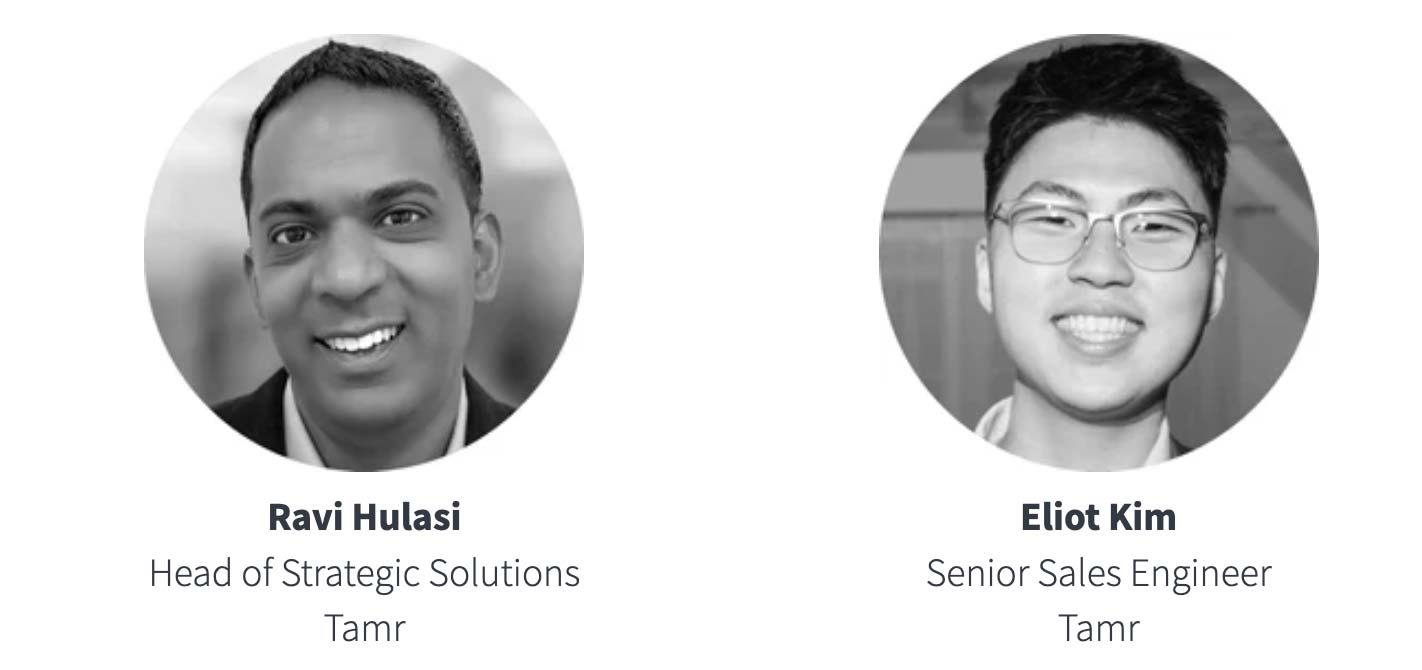
Hear from our expert speakers:
Key capabilities you’ll learn about include:
- How Tamr’s trusted 360° views solve data challenges across B2B, B2C, and Product uses cases
- How data curators can provide stewardship and governance without being overwhelmed
- How Tamr supports real-time integration with operational systems like Salesforce and AI tools like Claude
- How Tamr surfaces valuable insights about your data and quality improvements

Watch the recording of the overview and demo Tamr delivered at the Dataversity Demo Day! Our experts cover Tamr’s value proposition and discuss our unique, AI-native approach to delivering master data across domains to provide trusted context for analytical, operational, and AI applications.
Discover how Tamr delivers faster time-to-value, is more scalable, has a lower cost of ownership, and delivers better data for organizations across industries
Hear from our expert speakers:
Key capabilities you’ll learn about include:
- How Tamr’s trusted 360° views solve data challenges across B2B, B2C, and Product uses cases
- How data curators can provide stewardship and governance without being overwhelmed
- How Tamr supports real-time integration with operational systems like Salesforce and AI tools like Claude
- How Tamr surfaces valuable insights about your data and quality improvements
Watch Webinar!

Want to read the transcript? Dive right in.
Speaker 1
Hello, and welcome. My name is Mark Horseman, data evangelist with DataVersity. We'd like to thank you for attending DataVersity demo day, master data management. We're very excited to have you join us for this event set up to give you an overview of tools and services available for your enterprise data management programs. Just a couple of points to get us started due to the large number of people that attend these sessions, you will be muted during the webinar. For questions, we'll be collecting them by the q and a section or throw them into chat.
If you'd like to chat with us or chat with each other, we certainly encourage you to do so. And just to note, the Zoom chat defaults to send to just the panelists, but you may absolutely switch that to network with everyone. To open the q and a or chat, you'll find the icons for those features in the bottom middle of your screen. Also, sure to check out the resources tab for links, documents, and information about today's speakers. To answer the most commonly asked question, as always, we will send a follow-up email to all attendees within a couple of business days containing links to the slides. And, yes, we're recording, and we'll also send a link out to the recording of this session as well as any additional information requested throughout the webinar.
Now welcome to our fifth and final session of the day with Tamer and speakers Ravi and Elliott. Ravi is the head of strategic solutions at Tamr where he leads efforts to help organizations unlock the full value of their data through strategic guidance and implementation expertise. He works closely with clients to drive successful adoption and measurable impact from Tamr's data mastering solutions. With over twenty years of experience in enterprise data management and technical leadership, Ravi has a proven track record of developing innovative solutions and bringing cutting edge products to market on a global scale.
Elliot is a senior sales engineer at Tamr with a background in both presales and post sales who brings broad experience working at SaaS companies that serve companies across verticals, combining technical expertise with a strong understanding of client success. Elliott is adept at maximizing the value of Tamr's product capabilities to meet clients' needs. And with that, Ravi and Elliot, take us away for the rest of the day. And you're muted, by the way, if you hadn't noticed.
Speaker 2
Wonderful. Thank you, Mark, for a warm welcome. Today, we're going to walk you through Tamr's MDM solution and show you how it's solving many of the problems prevalent in the MDM market. From there, we'll give a demonstration of the, platform and follow-up with some hints and tips on how to get started.
So I am as Mark mentioned, I'm Ravi Halasi, head of strategic solutions. I'm joined by my colleague, Elliot Kim, senior sales engineer. And, you may remember us from last year's presentation, in which case, welcome back. If this is your first time seeing Tamer's datavarsity demo day, well, thank you for joining, and, we hope you find this content today to be impactful and insightful. So with that, let's get started.
Well, Taima is the only AI native MDM solution on the market, and we're here really to change how people consider MDM. We are born out of academic research from MIT, which looks into using AI and machine learning to go and improve MDM and allow it to be, performed at scale and in an efficient manner.
We have over nineteen patents that focus on a couple of key areas. Firstly, the use of purpose built and optimized AI and machine learning techniques to master data and manage it across the enterprise.
Secondly, the use of, AI agents guided by humans to accelerate and reduce the amount of curation that needs to be manually performed.
We're a multi domain solution so that we can, deliver optimal solutions for different use cases by means of delivering data products targeted to specific domains.
We have open APIs, which allow us to, support both analytical and operational use cases.
So the regardless of where you are, whether you start with analytics or operational, we can support you as you go and deploy MDM across your environment.
And we're delivering all of this as a SaaS solution that's engineered for performance, is secure, scan scalable.
As we are a multi domain solution, there's lots of different use cases and industries in which we've been deployed. And what does multi domain mean? So at its very core, of course, it refers to how data is being matched and mastered together. But from our perspective, it goes beyond that. It goes into looking at how the data is managed from a schema perspective, but also a consent perspective.
And then once the data has been mastered, how are golden records being set up, created, maintained? Because the definition of those could vary depending upon the domain of data and how it's being consumed.
Not only that, getting people involved, having permissions, those vary as well. And, of course, each domain has its own set of trusted external data which needs to be brought in. So regardless of the domain that you're working on, Tamer has you covered.
Before we talk a bit more about Tamer's approach to MDM, let's consider how people in the industry go and really deal with MDM today. And and really from perspective of the challenges that exist with dealing with large amounts of data and varying amounts of data. Well, the first option is to really do nothing, which isn't really an option as the amount of enterprise data is constantly growing, and so something has to be done about it. It.
So what do people do? Well, often people will try and build up their own process themselves. That is put people in place, maybe build a homegrown solution, writing a bunch of SQL, maybe pulling some different tools in, and and that gets you started and certainly applies many of the principles of MDM. But it very quickly reaches a ceiling because the amount of data and the process around it, can be difficult to maintain.
And, of course, having people go in and doing that setup really can get quite difficult to manage, over time as well. So, ultimately, we find that, people come to Tamer when from this situation where they're just unable to cope with the sheer amount of data that's coming in and and how to scale this particular, process.
Another way people look at MDM is to process around it, and this, often involves deploying a traditional legacy based MDM solution, going in, building out a bunch of rules, and, setting those up, which, again, is is great to get you a basic master. The trouble is, over time, data is constantly changing. We all know that. But, also, the the people who are setting up and maintaining those rules may have moved on to other roles.
And so you end up with this legacy set of, rules that are there when no one really knows what they do or why they were put in place. And so they they become difficult to maintain. One might say they're brittle. So it becomes difficult and costly and complex to go and, keep this sort of system going on.
So the alternative way is to be more productive. This is where solutions such as Tamer comes into play because by using AI and machine learning, we're able to scale the mastering of data as both records increase as well as when sources increase as well.
This reduces the total cost of ownership of the solution as you're not having to go through and set up and maintain rules, but instead of focusing your time on consuming and curating the data.
A machine learning approach also offers a higher level of accuracy in the results, and the setup itself with Tamer is is quite quick as you'll see in the demo later on. So this delivers a faster time to value as you're not having to go and get a ton of professional services to get you set up and and to maintain things.
So let's take a little bit more of a closer look into Tamer's approach. Well, as I mentioned, we use AI and machine learning at the core of the problem. And there, we're going to use these pretrained models to actually go through and perform that mastery task. The idea is that this takes care of the vast majority of the data mastery in that conditions.
Of course, there's going to be edge cases. And edge cases, when they do happen, can get routed through a curation workflow. You'll see that in the demo today. And that curation workflow can apply to tasks to be carried out by humans, or they could also apply to tasks to be carried out by patients.
So there's a really nice flow there that allows those edge cases to be attended to without them being becoming burdensome. And, of course, every business has their own specific needs and requests in each domain, and so we have a layer that allows you to put on top business specific rules for how to treat the data. And that could be how to master the data or indeed how to go ahead and consolidate to, to a particular definition of golden record or even how to share the data because there may be different consumers of the data who need to have different views of of the master data itself.
Throughout the industry, we've seen that many people consider MDM almost as a onetime cleanup of the data. That is source data comes in, runs through a process, stuff gets published, and then everyone goes on their way. But those of us who are dealing with data know that things are always changing. So a onetime cleanup is not really going to work, and running that same source of approach and process multiple times gets you so far, but it's not really adapting to the needs of, the data life cycle.
With Tamer, we're engineered and optimized to deliver always on improvements. What that means is we have a set of open APIs which allow us to treat data as it's being created, updated, or even removed. And this means that data quality becomes a much more instantaneous process. You're no longer having to wait for batch flows to run.
Instead, you can make sure that accurate clean master data is being created as and when these events occur.
And so let's look at an example of how this, runs in practice. So here's here's a simple scenario. You have a, a person placing an order of some bits and bobs that goes and gets executed on an ecommerce site through various different systems. You've got the actual order fulfillment, maybe some follow-up marketing, and then the actual delivery of the, of the items in themselves as well as the inventory management.
And many, organizations, each of these functions deals with a single version distinct version of that customer. So data siloed. And the problem there is that the customer experience really does degrade because, let's say, they have a problem with their order, the information in the logistics fulfillment system may be different than if they go in and look into maybe get some coupons applied or or interacting with another system.
And this causes challenges, especially when, let's say, data needs to change. Perhaps, the customers put a different, different address and they want to change the shipment. Where does that go? Which systems get updated? How do we make sure that we're capturing and, really understanding data as it's changing?
So to do that, this is where Taima creates a single view of an individual. And to achieve this, there's a couple of things that take place. Firstly, we have those real time APIs, which allow us to create the customer record if if they don't exist or update it as well. These actions are going to go through and resolve if there are any particular duplicates that are present and maintain a single golden record that can that other systems can then subscribe to. Not only can they subscribe to the to the golden record, but they can also make changes to that golden record. And so in this manner, you have a single version of a truth that is able to be kept up to date, and all concerned systems can be made aware of those changes.
And that delivers a far more fulfilling experience for the customer. Things are less siloed, and internally within the business, there's a clear view of who the customer is and what their interactions with the company are.
So data integration really focuses on a couple of different areas. I mentioned APIs already. So Tame has got a suite of open APIs that allow us to do record level actions within master data. And that that's a that's a critical point because to support operational use cases, you need to really be working at that record level. So we have the APIs to go search, create, update those records.
And, naturally, for onboarding data or or with mass actions, yeah, we're going to be able to read and write from common cloud object stores as well.
We can also integrate with, more esoteric systems through integrations with bypass systems.
And a common integration that we see is the need to connect to, enrichment providers. So TAME's built out connectivity to a vast number of public and commercial, enrichment providers, including Dun and Bradstreet who are strategic partner of TAME.
I mentioned it earlier the ability to have systems be updated and made aware of when master data records change. So not only can that be done via publish of the data, but it can also be achieved using webhooks so other systems can subscribe to webhooks to consume those changes.
And, of course, it's not just discrete systems and humans that need to interact with the data, but also other enterprise agentic systems as well. So Tamer has an MCP server to allow those systems to get access to the trustworthy data.
Now, of course, mastering one domain can, be be a challenge, but many enterprises have multiple domains that they need to take care of. And often, these domains have data that's related. For example, a supplier could also be a customer.
Tamer supports this by allowing you to create, manage, and update relationships within and across different domains.
This allows you to set in place the foundations of that graph. So as a multi domain solution, we can go from solving a single use case through to an enterprise wide foundation for master data, taking into account the relationships across different domains across the enterprise.
Now, of course, master data is only as impactful as the impact it has on business, and Taima has had a tremendous impact since we came to market in twenty thirteen.
Many customers see an increase in revenue by being able to realize an optimized view of a customer or or achieve enhanced segmentation, both of which are accomplished by building a single view of an entity across multiple sources.
Other customers look to tamer and achieve better operational efficiency. The use case I showed earlier with the online order fulfillment is a great example of that, breaking down silos and streamlining operational processes to drive customer satisfaction and efficiency.
And, also, many customers have reduced spend overall by using Tamer to consolidate and then retire legacy master data systems.
We achieve this across multiple domains, across multiple industries.
And with that, I'm going to pass over to Elliot to show you what Tamer can do in action.
Speaker 3
Thank you, Ravi.
So to set the scene here, I will walk through the journey of what a day in the life would look like for a Tamer customer. First, I'll walk through understanding how Tamr visualizes a golden record and the ability to create this web of information through enrichment and relationships. Then I'll walk through Tamr's curator hub to show you the reconciliation process to handle curation in intuitive and seamless way. Then before I hand it back to Ravi, I'll go over configuration and the insights that Tamr provides as well.
So let's get started by taking a look at a company golden record. So in this example, Kroger.
Tamer has already automatically clustered records together across all your different sources, and then it cherry picks the highest quality values to be a part of the golden record. Then, of course, it takes it a step further in lot of different ways. The first one being verified match.
So Teamers verified match leverages an internal corpus of about five hundred fifty million different companies to improve your cluster confidence, but also verify a company's legitimacy. Right?
Then Tamera will standardize fields like website, email, and address so that they're consistent and standardized across all your records without any additional configuration.
Something to note at the top here is this tamer ID. So this tamer ID is a unique ID that is assigned to every golden record, but more importantly, it's also associated with all the source records that are part of this golden record as well. So that way, when you inevitably publish this out to a different source or data link or data warehouse, you'll still have a common field or a point of reference to be able to associate all these record records together outside the context of this UI for reporting or any other use case.
And, of course, if you wanted to add any additional fields or custom attributes that you want to associate or be a part of your golden record, you have the ability to add as many of these as you'd like.
As we scroll down, we get to see all the different components that make up this golden record. Right? So out of all the sources that Tanner has access to, you can see which unique sources or how many unique sources contribute to this golden record, how many records were automatically clustered together, as well as all the distinct values that Tamer had to work with to be a part of the golden record.
You have that same visibility for enrichment as well. You can easily see all the values that were enriched and automatically associated to the golden record across all your different enrichment sources.
So instead of having to manage your existing subscriptions yourself, Tamer will automatically handle that for you as well.
Understanding how a particular customer relates to other customers is always important in identifying, white space and context. Right? So with your existing source records, Taylor will actually automatically create a company hierarchy for you backed by Tamer's enrichment to help you understand how a customer organization relates to other golden records.
But I'm sure you're thinking, you know, what if you wanted to create golden records together outside the context of this enrichment? Right? And like Ravi mentioned, that's where relationships come in.
TeamR allows you to define relationship types and link golden records from the same or different entities together to create that web of information as soon as a record is created. So in this example, we're just looking at a a relationship between Kroger and the key decision makers that are part of it to help you make more data driven decisions all in one place for you.
Let's switch gears and talk about a different entity TMR can master, a consumer or Diane Arnie in this case.
So the exact same concepts of what you've already seen here or seen apply here.
However, because we are looking at different attributes and different attributes apply for people, the UI, of course, adjust accordingly. So since we're looking at Diane and Arnie, you can easily see the information that is important to you as as such as the consent for the method of communication.
Similarly to the hierarchy that we just saw, another way that Tamer will automatically create, relationships or view or expose relevant information is householding. So say we are viewing, of course, the Diane Arnie's record, but you wanna know someone in if someone in their household is also an existing customer. Right? TeamRail automatically surface other golden records that do share the same address and the ability to easily view their golden record as well.
The best part or my favorite part of all this is that you have the ability to continuously clean your data both automatically and have it be user suggested. Right? Tamr will automatically bring up records that fall below a definable threshold for users to then suggest as a potential duplicate to a customer to merge or edit, which I will show you in a second.
But before I do, just want to quickly show that, of course, as a part of the golden record as well, you have the full audit capabilities and the ability to see any action that was taken on a record, whether that was a curation activity or any API call. So what changes were made, who made it, when, when the change was made, as well as what values were changed as well.
Okay. So going back to curation, right, and how easy it makes or how easy Tamr makes it to curate on a record, like, Philip, Arne that we just saw.
So it can be pop this carrier inbox can be populated one of two ways, right, through the user suggestion, as you just saw, or having Tamr automatically populate this inbox based on, again, that definable threshold on based on your business use cases. So in this example, you can see that there's a difference in name here. Maybe there was a typo in the address and likely why, it was surfaced into a curation hub for a human in loop first or someone to take a look at. You can see which values were exact matches or partial. And to take it a step even further, if you wanted to see some explainability to make help you make that decision a little bit more confidently, you have the ability to see exactly why these records match and a little bit more insight into the match labels as well.
So with this, obviously, you can imagine how easy it is to actively maintain your data quality as new records are coming in.
So while we're in this curator hub, I wanna quickly show a, different curation item for a different entity. So like Ravi mentioned, Tamr is multi domain. So you do have the ability to master a lot of different domains, like location or custom entities or any relevant, entity that's relevant to your organization. But in this case, we're looking at an example of products.
Right? Tamer masters products the same way it masters people in organizations. But, of course, not our products are the same. So if you did wanted to bring in any of the fields that are important to you to be a part of the golden record, you have the full flexibility to do so.
And just like before, you still have the ability to easily curate and reconcile these suggested merges.
K. So now that you've seen how easy it is to interact with Tamr, let's quickly walk through configuration and how easy it is to bring in a source.
So out of all the sources you've given Tamer access to, you have to simply select the sources that you wanna master.
Tamer will auto map as many of these fields to golden record attributes. And, of course, you still have the ability to select the attributes for yourself or view or preview the sources directly from here.
But something to note is that the adding or removing the sources does not affect the existing configuration, and this is designed to be a one time setup. But more importantly, your existing configuration will dynamically scale whether you add or remove any of your sources. So once you've brought in your source and mapped it and let Tamr know where the golden record attributes live, you're now ready to run your first iteration of Tamr. Right? The pretrained patent and machine learning models will then take care of it for you and take care of that clustering without you having to write any rules.
Then, of course, adding enrichment sources couldn't be easier. We call it one click enrichment because it's a matter of just checking a single box to have Tamr manage and associate your enrichment subscriptions data to your golden records. And, of course, if you have any additional sources outside of Tamr's partnerships, you can still leverage that and bring that in as a source as well.
So I'm thinking great. You know, I brought in my sources. I let Tamr customize records automatically, But how do I know that it's done a good job? That is where our insights page comes in there.
Right? So you can think of this page as your report card to have clear visibility into the before and after Tamer. Right? You have insight into your data quality.
You have insight into your deduplication rate, how that's changed over time, help you point you in the right direction to make sure that you are attempting to stop your bad data coming from the source.
How complete is your data?
How how your sources have changed over time? And And all these information is available right at your fingertips as well because the fact that you can also drill down and investigate further on any of these KPIs or metrics, and further investigate without having to leave So now that you've seen how Tamer visualizes a golden record and how users can interact and be proactive with the information that it brings together, I'm gonna pass it back to Ravi who will show you this all in action, right, to show you the power of Tamer from an operational and real time use case.
Speaker 2
Oh, fantastic. Thank you, Elliot. So I think you've you've all seen there just a really rich curation flow that that people can engage with, multiple queues and lots of ways to to interact and really handle those edge cases.
What I wanna talk about now is a bit more of an operational flow. And so I mentioned earlier, we've got these rich APIs that can be used to connect to different systems. And and one of the biggest areas that we're seeing growth and and adoption with Tamer is the use and the and interaction of Tamer and agentic systems. And and that that makes sense because, well, you hear it from me that agents are only as trustworthy as the data they can reach.
And so it makes obvious sense to have an agent, an enterprise agent, go and use a trusted source of clean curated data produced by Tamer. So let's see how this could work in action.
And so here I am with with access. I'm an analyst. I'm working in Claude. I want to do some segmentation, some some analysis. And so I've gone through, and I'm researching some customer accounts.
And seen the example that Elliott showed with Kroger. I want to understand other subsidiaries of Kroger that we can go after and do some outreach for. So I'm asking Claude here simple question. Go go find me some some subsidiaries and see see who we can go and target.
And so Claude's going and searching the web. He's found out here the top five subsidiaries for Kroger in the Southwest. And, now it's going to check sec to see, do we have any relationships with them within Tamer? And so looking through this, we can see that there's a couple of them are in Tamer and a few that are not.
To do this, we have Claude connected to Tamer's MCP server. So he's actually going and making a call to to see do these customers actually exist in Tamer or not. That's where it's getting the response from. So we can see here there's a couple there for, Fry's Food and Food for Less and City Market.
And, actually, as an analyst, I I actually play pickleball with someone at Fry's Fry's in Joe Max Road. So let's add a record there, and we can see how Tim is going to add that record too.
So in a similar manner, Claude is interacting. He's doing a search on the web to find out the address for this particular Kroger fries branch rather and asking me if I want to create that record. So you may guess what's gonna happen next. It's going to go and create that record in Tamer.
There we go. It's created this particular link. And so it's just added it and asked if I want to add any contacts. But for now, I'm just going to go and take a look at this link here and see what that looks like.
So if I browse over to this record, we will see fries, food, and drug, and there we are right next to Joe Max Road. So this record has now been created in Tehama. It's got a Tehama record ID, and and that's all really great. So, firstly, the record's been created in the master data system, and now we can interact with it. But not only can we interact with it here, but I mentioned earlier on the ability to alert other systems that new records have been created or mastered them. What we've actually done is our analyst team actually work in Salesforce.
And so wouldn't it be nice to actually alert Salesforce that fries, food, and drug is an account we want to look at?
So what's happened behind the scenes is Webhook was sent out and consumed by Salesforce to say, hey. Here's a new record to go and create. And so now I've got this record here. It's got it's got a link back to tame as three sixty, and that's great.
So that's that's showing one direction of integration. But, of course, you can integrate and send data the other way as well. So, one example could be to add in the phone number, and I'll just give a quick, example there and create that particular, fax number, and, actually, I'll pop it in the phone. Let's do that.
The key point being that I'm making a change in Salesforce, and now that's triggering an update from Salesforce to this golden record. So if we go back and take a look at this golden record, we can see their primary phone number has been updated in that manner. And so this is a great way to show humans and machines and agents all interacting together in this way to go and, really deliver master data and get it out into lots of different systems.
So with that, I think I've I've that's like to say that you've seen Tamer in action. We've seen how we can go through and create master data. We do it really quickly with minimal fuss, and we keep it up to date and and build a really accurate, high quality view of multiple domains. We make those available across the enterprise.
We do it faster, better, and cheaper than other solutions. You don't need a ton of professional services to get up and running. Many customers start building out their first flow from day one and really extend their MDM experience from a single domain all the way through to a multi domain MDM deployments with minimal fuss, minimal stress, and you don't need a ton of professional services to get started.
And with that, I'd like to thank you for joining us for, demo day today. And before I go, I just wanted to, point out a couple of, resources that will be really helpful. Firstly, you've seen what we can do in this demo. We'd love to do this with your data. So check out this first QR code to schedule a custom demo. We'll take your data through Taima. We'll show you how we can improve it both for analytical and for operational use cases so you too can realize the goal of clean, trusted data being consumed throughout the enterprise.
Secondly, Tatum's got a lot of experience collectively of helping customers whether they're starting out with MDM or looking to modernize their existing MDM deployments and make use of all the good pieces they have and, take that to a next level. So we've collected all this information into the MDM journey ebook. That's the link in the middle there. You can download that. Lots of hints and tips to get started.
And finally, as we showed how agentic data curation is really a, an important growth area now as well, and it has an effect on data mastering. So check out this third QR code here for our perspective on how to do that effectively and allow humans, curators, and agents all to coexist with clean master data.
And with that, I'd like to thank you for your time today. Thank thank you, Elliot. For this, you may have noticed when wearing the data nerd shirts, you may have you can see why now. And with that, I wish you happy mastering and pass back to Mark to help us wrap up for any questions.
Speaker 1
Yeah. Thank you so much, Ravi and Elliot, for that great presentation and echoed by one of our community members in chat that they really appreciated the demo. So thank you. And I was messaging with a friend here when you were going through that demo of adding the phone number into Salesforce. It's remarkably fast how quickly that gets into into the Tamr solution.
So that kinda leads me to to a question. As you know, Ravi, I've I've been around the MDM bandwagon for, oh gosh, thirty years.
So if we've got an MDM team that, you know, dedicated, understand MDM really well, but they're not necessarily the strongest with with AI. They don't have a a comfort level with the with AI tools.
Is that going to affect that team's ability to use Tamer? What's the best way to overcome that maybe uncomfort level with the AI tool?
Speaker 2
Yeah. Thanks, Mark. That's that's a great question. And, yeah, I I think it it ultimately falls down to MDM.
There's common principles to it. We want to match, mask, and merge data. AI is an accelerator of that, but you don't need to be a data scientist to have to go in and set up and and understand all the mechanics and computation that's taking place. That's ultimately what we've done.
The key point is, though, is that you need to have trust and confidence in the data. And I'll just call back to when I think we're showing CuratorHub. I think one of the most impactful things is the way in which you can actually expose different pieces of information to guide, in this case, a human to review records. And and so you you saw Elliot show the color coding there.
And then if that's not enough, we have to expand that and have even more detail to explain exactly why records are matching or being brought together. So it's really a scale of saying, yep. These records should be reviewed.
Why do they need to be reviewed? Okay. Let's take a look and get more detail. Indeed, this could even be information. There's plenty of metadata within that, within that, particular, case where even an agent could use that to consume as well. So the key point is that we calculate these metrics and metadata. We surface them in a way that means you don't have to be a data scientist to to understand and act upon it, and we do it in a manner that's comprehensive so we could have machines also providing assessments and interpretations, especially going through through an agentic system as well.
Speaker 1
I I noticed you used Quad as part of this demo, and and there's a few MCP components that I could see here. Is is this truly, like, a bring your own model kind of solution and people could use whatever? Do you see clients using a variety of models?
Speaker 2
Yeah. So so, personally, I I'm quite a fan of Cloak. That's that's why we ended up using it in the demo today. But but, certainly, lots of customers are using things like Copilot.
Today, I was actually interacting, emailing a customer, and she had the I think it was Copilot badge of honor in her email signature. So, yeah, I that's the first I've seen that. But the key points there is that, yeah, as by exposing an MCP server, there's no reason why any enterprise agent tech system could not do the same sort of thing that that I showed in my demo, being able to connect to Tamer as an authoritative source for for clean master data. So, yeah, where it would it really builds upon Tamer's approach to integration, having open APIs, open integrations so that nobody's locked into a particular vendor.
Speaker 1
Cool. Speaking of vendor lock, that's a good segue. If if a customer has, like, an older MDM platform or maybe they're stuck with something that was homegrown by some developer thirty years ago. What is the best way to not lose the the merging and the the rich data that came from a system like that? How can Tamr help leverage that old system while migrating to to Tamr as a solution?
Speaker 2
Yeah. Well, we've we've done quite a lot of this, actually, and it it's a common question that that we see where where folks have some way, shape, or form of MDM, and you don't want to throw that out completely. And I think key to key to a successful migration over is to understand what's worked well, what what hasn't. So, for example, if there is a master, let's say, of our customers or maybe even students, then let's see let's see.
Do we want to keep those? If they're working, great. If you got those IDs and those are fairly well trusted, fantastic. But let's understand what maybe isn't working and and focus the effort of a migration on there.
So, ultimately, it becomes a a case of choosing what assets do you want to migrate. Is it the IDs? Are there particular, business rules or logic that needs to be moved over? Are there particular sources that you'd like to have integrated but couldn't?
Let's understand that scope and also the roles and behaviors of people today because, certainly, I've seen the case where some folk are they they end up sweeping up sweeping duplicates onto the rug just because they don't have a process to actually deal with that. So in that case, that's where introducing capabilities such Curator Hub can be really transformational to Teams and enabling them to do things they haven't had time to focus on, let alone thinking about integrations in real time or even integrations to MCP servers. So, ultimately, that the key point there is that you're not losing the hard work you've done, but you're able to extend, modernize it, and really make it even more impactful across the enterprise.
Speaker 1
I I love the call out to students because that was my first project was working with with student data. So we've got a couple minutes left here. Do you guys have any other parting thoughts you would like to share with our audience?
Speaker 2
Yeah. I think, yeah, from I'll go first, by all means, Elliot, feel free to chip in. Yeah, for me, it's we're just we're in a unique moments where there's even more pressure to deliver clean master data because now it's not just systems and feeds and humans now. We've got agents. And I think that that's also a driving factor. It's compelling events.
So while folks are going and taking careful consideration to the use of agentic AI in the enterprise, also take careful focus and consider consideration to how your master data can support that. So I think the two together can be especially impactful and, allow you to really take advantage of the capabilities of HNTKI.
Speaker 3
Yeah. And one thing I'd like to leave with, everyone here as well is just calling back to Ravi's slide about the onetime cleanup versus a continuous cleanup. Right? I think Tamer's focus on yes.
Of course, we'll clean your data, but the focus on continuously keeping it clean in real time and operational use case as new records are coming in are just as important. Right? We're trying to move away from this washing machine. Let's clean up this big mess every once in a while and hope for the best.
And in that intermediate time, not know how clean or confident your data is and allowing you to have resources like the Curator Hub and explainability to continuously have humans in the loop while making sure that any new records coming in are always continuously cleaned.
Speaker 1
I I love that call out. And I just I love that emphasis on how master data data is so much more important right now than it's ever been. I I always like to say that bell bottom jeans are coming back in style.
There there was a push to care about MDM in the eighties, and then it kind of faltered off. And then it was popular again when people cared about identity and access management. But now with AI, it's popular again. Exactly. Yeah. Yeah. There's gonna be another resurgence, I'm sure.
Well, I I we do have time for one more question, and and and I'll let you knock this one out of the park. This will be a fun one. With lots of MDM vendors out there, we see, like, all of these MDM solutions.
What in your mind makes Tamr really stand out from the pack?
Speaker 2
So I think I think it's the approach. So, certainly, when when we talk to customers with an existing MDM solution, they're asking for core capabilities, short connectivity to data, the ability to match records together, the ability to do survivorship and form curation. So the concept of MDM is well known. It's just the challenge people have is really the approach and how much time, effort, blood, sweat, and tears of joy to actually go through and set things up.
And, it really comes down to that challenge of of of how do you manage that process. Do you want to spend your time managing rules? Do you want to spend your time enabling curation of those edge cases? And I think that's where having the AI first approach allows you to scale, but also still allow you to layer on top of those rules as well.
And, yeah, I think that's that's where I see a unique a unique foundation point and certainly around curation, Elliot. Any anything to add around that?
Speaker 3
Yeah. I think that curation of highlight is a really big differentiator because, again, understanding how you can have a human in the loop while leveraging AI, being AI ready is great, but not having the explainability can be always, one step forward and two steps back. Right? So actively understanding how AI is contributing and automating your ad hoc tasks while not having to write and manage these rules as you're scaling and adding these more sources while not compromising on the complexity of configuration or your efficiency is a really powerful factor and why Tamer has invested so much time and effort into making sure that Curator Hub is as intuitive intuitive and and seamless as possible, especially in the context of even being able to have a definable threshold of what populates in the Curator Hub automatically, but also from a user suggested perspective as well.
Speaker 1
I love that, Elliot, and I love the the focus on human in the loop. And you said it a number of times, it's just so important to make this stuff work.
That's all we have time for for today. So thank you for the wonderful presentation. Thank you to our community for supporting the the last session of the day and and hanging in there with us, and and Ravi and Elliot for making it a wonderful, wonderful presentation to close out our day. So thank you very much, everybody, and have a wonderful rest of the day.
Speaker 2
Thank you.
Speaker 3
Appreciate it. Thank you.