.svg)

Enterprise Knowledge Graphs: How to Find Connections for Your Data

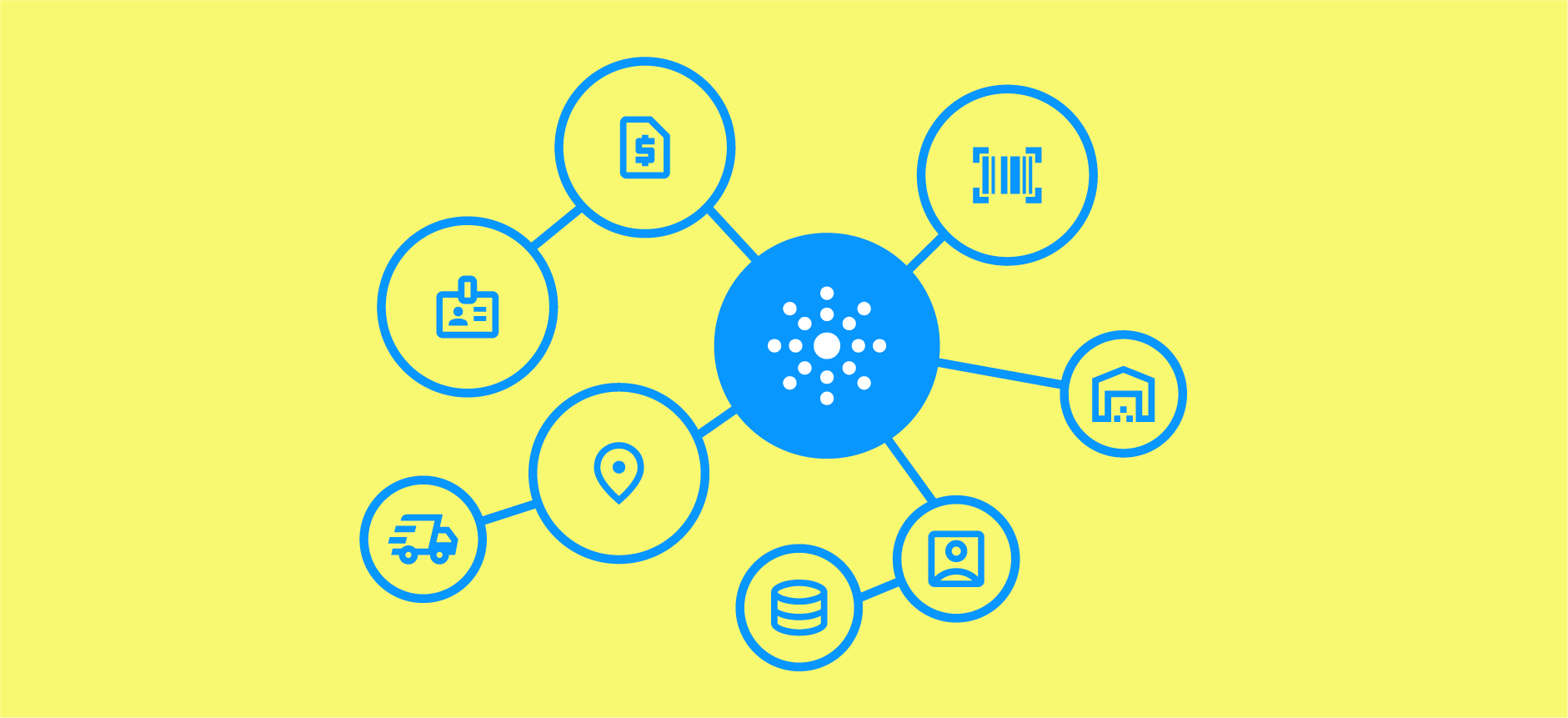
If your company is like most, you’re managing structured and unstructured data scattered across hundreds—or even thousands—of sources. And while finding the data you need is hard, bringing it together in a way that helps people see the connections between it is even harder.
Today, Tamr does a great job of using persistent IDs to resolve disparate data into golden records for key business entities like customers, suppliers, contacts, employees, etc. But increasingly, stakeholders want to understand the broader business context, including how these entities relate to each other. That’s why organizations must now go beyond simple entity resolution to link these entities—and their complex relationships with each other—together in an enterprise knowledge graph.
What is an Enterprise Knowledge Graph?
An enterprise knowledge graph is a connected, contextualized view of an organization’s data that highlights the relationships among and between key business entities. By identifying these cross-entity relationships, organizations can reveal meaningful connections that surface valuable, actionable insights.
Using enterprise knowledge graphs, businesses can uncover complex, interconnected relationships within their data such as:
- Customers who are also suppliers or subsidiaries of suppliers
- Contacts who are also employees of the company
- Alumni who are also employees, grad students, or parents of a current, former, or prospective student
- Healthcare providers who are part of a practice that is affiliated with a healthcare system
- Consumers who are part of the same household
Enterprise knowledge graphs also take into account the directionality of a relationship. For example: I am an employee of Tamr, but Tamr is not an employee of mine.
What Value Does an Enterprise Knowledge Graph Provide?
Enterprise knowledge graphs build trusted, real-time views across people, organizations, households, and associated items like products, orders, invoices, locations, and more to reveal deeper insights within the data, allowing you to answer complex questions about your key business entities.
To illustrate this point, let’s consider a consumer example. Imagine you search Google for the recently released movie, Wicked: For Good. Not only does Google return basic information about the movie, but it also surfaces related details you didn’t explicitly search for, such as who is the director; which actors are in the cast; how it scored on IMDb, Rotten Tomatoes, and Fandango; and where the movie is playing near you.
This added context may spark additional questions you wouldn’t have otherwise thought to ask, such as “When is the movie playing near me?” or “What other movies has Jon M. Chu directed?”
While this consumer example is relatively simple, the same concept applies to more complex enterprise data. Consider these scenarios.
A financial services company wants to uncover opportunities to cross-sell and upsell a new teen checking account product to its existing customers. By connecting customer entities who belong to the same household, the firm can more accurately assess which customers could benefit from this new offering, and balance this opportunity against any potential risk from a customer with a poor credit history. Rather than just looking at each customer as an individual, the knowledge graph allows them to target their financial advice based on the household’s combined situation, not just the status of one individual. As a result of these richer insights, the company is more likely to uncover new revenue opportunities and improve customer relationships, while also reducing Know Your Customer (KYC) compliance risk.
Here’s scenario two: A global luxury retailer knows that 80% of their revenue comes from 8-10% of their customers. So, it’s incredibly important that they understand the connections between customer entities. Take, for example, a top-tier customer shopping in New York and making a purchase. Then, later in the day, the shopper’s spouse enters another retail location and creates their own account. Having the ability to immediately connect these accounts—as well as any additional online shopping activity for the shopper and their spouse—into a single, household view is key to identifying them both as top-tier customers, tailoring marketing and promotions specific to their purchasing behavior, and delivering exceptional experiences across the customer journey.
The Benefits of Enterprise Knowledge Graphs in MDM
Tamr’s AI-native master data mangement (MDM) solutions allow organizations to connect fragmented people, organizations, and other data across systems and silos to create enterprise knowledge graphs. By connecting the dots across the most important business entities, Tamr uncovers meaningful connections and reveals valuable, actionable insights. And when you connect these enterprise knowledge graphs to AI reasoning systems, these systems become even smarter and more “human” in their reasoning abilities.
Using powerful AI-powered entity resolution, Tamr connects relationships that rules-based MDM solutions often overlook. Tamr’s persistent ID, linked through these graphs, gives AI agents the knowledge to navigate the data in siloed systems as they take action. And, with real-time insights and flexible models, Tamr can deliver trusted relationship data directly into operational workflows while adapting to evolving business needs without the need for re-tuning.
By using Tamr to create enterprise knowledge graphs, organizations can:
- Identify relationships between people and companies to drive smarter targeting, recruitment, or business development.
- Create a unified view of healthcare providers and organizations to uncover connections such as affiliations and referral pathways.
- Identify 360-degree consumer views of households to drive smarter targeting, better engagement, and strong customer relationships.
Connecting the Dots for Smarter, Faster Decision-Making
By creating enterprise knowledge graphs that connect critical business entities across a multitude of sources and silos, businesses gain a 360-degree view of information that reveals interconnected relationships that enable stakeholders to quickly make better, more informed decisions. Further, enterprise knowledge graphs go beyond organizing entities to find meaningful links between them that organizations can use to enhance their AI applications and drive results such as increases in revenue, decreases in cost, and a reduction in risk.
Get a free, no-obligation 30-minute demo of Tamr.
Discover how our AI-native MDM solution can help you master your data with ease!