.svg)

AI Agents: Meet Your New Data Teammates

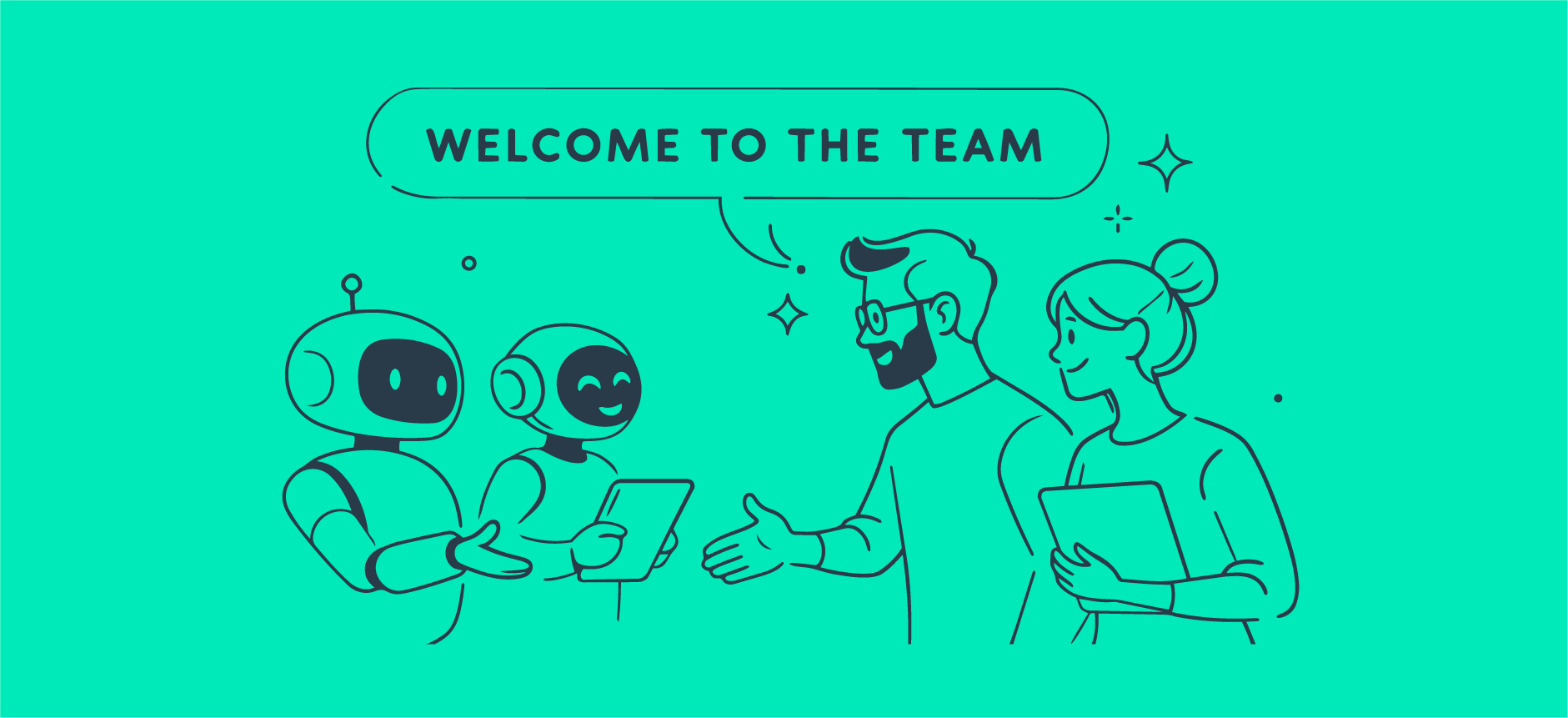
The next new hire you add to your data team may not sit in a cubicle, ask you a question via Slack, or attend your daily standup. But they will analyze and curate data, make recommendations and decisions, and actively participate in the data mastering process. They’re AI data agents, and they’re fundamentally changing enterprise data management.
AI data agents are quickly moving from experimental tools to active participants in master data management (MDM). They generate insights, curate information, make recommendations, and execute tasks in real time—making them active, collaborative members of your team. But just like any new hire, data agents need onboarding. They need to understand how data is defined, where it lives, and whether or not it’s trustworthy. They also need a set of clear guardrails to prevent them from going rogue.
If AI agents are your new teammates, then your organization must clearly define their role on the data team—and how humans will work in collaboration with the agents to deliver trustworthy insights to everyone who needs them.
From Automation to Collaboration
When first introduced on the scene, AI data agents often acted as an automator. They streamlined simple, repetitive tasks, accelerated routine processes, and reduced manual effort. Their scope of duties was limited, and didn’t include actively making decisions or orchestrating workflows. But as agentic AI for data management has become more sophisticated, the role of agents has evolved.
Now, LLM-based AI agents have the ability to play an active role in the data mastering process. They can curate data, surface duplicates, and identify gaps—putting data discrepancies that require adjudication into a queue for human review. They can also provide context for why a record is an outlier or flagged as a match so that a human can make an informed decision before resolving the issue or merging records.
Collaboration between AI agents and human data curators enables organizations to master more of their data faster, closing what’s often called the “last mile”—the 5-10% of data that remains unresolved after the mastering process—that requires more context, knowledge, and precision. And even though the last mile represents a small portion of the data, it can often consume upwards of 80% of a data team’s time to resolve. Collaboration between data agents and humans not only enables more data to be mastered, but it also allows data stewards and other data curators to refocus their time on other, more strategic data and AI initiatives.
Onboarding AI Data Agents: What Every Good Teammate Needs
Onboarding an AI agent for data analysis isn’t all that different from onboarding a new employee. After all, you wouldn’t expect a new hire to succeed without a clear definition of roles and responsibilities, access to the right systems and reliable information, and well-defined expectations and boundaries.
The same is true for AI agents. For agents to operate effectively—and avoid costly errors or hallucinations that could derail good decision-making or damage the brand—they need high-quality, trustworthy data; explicit governance guardrails; and a clear understanding of where their authority begins and ends. Without a clear, well-defined foundation, data agents may take matters into their own virtual hands, leading to ambiguous or inaccurate insights that cascade through systems across the organization.
To illustrate this point, a common analogy that is made is that LLM-based AI agents are like interns. When compared with seasoned employees, interns know relatively little. They lack the experience and expertise that come from spending years working at a company or within an industry. And the risk with interns is that you give them a task and they work really hard on it, only to discover that they’ve worked on the wrong thing. It’s not intentional—it’s just that they didn’t know any better or were confused.
Perhaps an even better analogy is to compare LLM-based agents to MBA interns. MBA interns are often even more confident and eloquent in the information they share, which makes you want to believe them, even though their information may lack sufficient context or be based on inaccurate data or assumptions. The same is true for AI agents for data management. Their responses are often bold and confident, yet the information fueling the insights can lack quality and trust.
The AI Agent Onboarding Toolkit
To overcome challenges associated with a lack of knowledge and context, organizations must prioritize the following:
1. Trustworthy, well-governed data
It goes without saying that clean, accurate, trustworthy data is table stakes for AI agents. When data is incomplete, inconsistent, out-of-date, or duplicative, AI agents don’t know which data to use. For example, if “customer” is defined five different ways across five different systems, the AI data agent will confidently choose one definition to use without awareness or consideration of whether the data is right for the task at hand. By embracing data governance and delivering clean, accurate golden records, organizations can eliminate ambiguity in the data, giving AI agents a clear picture of which data they can use and trust.
2. Clear role definitions and boundaries
To ensure AI data agents stay on task, it’s important to define the scope of their work. Without clear boundaries, data agents may assume authority they weren’t meant to have, such as making decisions or initiating changes that ripple across systems and disrupt decision-making.
To prevent this kind of chaos from occurring, consider what role your organization wants AI agents to play. Some organizations may want AI agents to automatically resolve entity matches when they are clear and straightforward, while others may prefer a human to review every proposed match before applying the change in enterprise systems.
By establishing clearly defined roles and boundaries, organizations can ensure that data agents carry out their assigned MDM responsibilities with confidence while escalating decisions that fall beyond their scope to humans for review.
3. Contextual access
Every new hire needs access to certain systems to do their job effectively. But in most cases, you wouldn’t grant a new hire unrestricted access to everything, especially not on day one. The same holds true when onboarding AI agents for data management.
Granting AI data agents access to specific, vetted systems and datasets is a good start. But you need to ensure the agents have context, too. When agents retrieve information from uncontrolled, ungoverned, or outdated sources, reliability is called into question. In contrast, when an agent has context about the data it’s using, usability and trust improve, giving humans more confidence in the results.
For example, when data agents can understand the lineage of the data, they can trace where the data is coming from, who owns it, when it was last updated, and if it’s complete. With this context in hand, the agents can determine if the data is usable as is—or if it is an anomaly or outlier that they need to surface to a human for review. Further, context enables data agents to spot potential duplicates so they can either merge them or add them to a queue for human feedback.
4. Monitoring and feedback
When you hire a new teammate, you don’t hand them a laptop and wish them luck. You check in, review their work, answer questions, and clarify expectations. You correct misunderstandings and redirect them when they veer off track, preventing them from forming bad habits that negatively impact their performance.
When integrating AI agents for data analysis into your data mastering processes, you must apply the same disciplined oversight. Monitoring and feedback loops are part of responsible onboarding for people and for AI data agents. Without performance tracking, error logging, and human review, small mistakes can quickly turn into systemic issues. With structured feedback, however, AI agents improve and make better decisions and recommendations, aligning more closely with organizational standards and operating with greater accuracy over time.
5. Explainability and auditability
Explainability and auditability are essential to building trust and maintaining control. After all, it’s normal to expect a new hire to submit their work for review, document decisions, and explain their reasoning, especially as they’re finding their footing. And you should extend that same set of expectations and standards when adopting agentic AI for data management.
AI data agents should be able to produce a record of the data sources and logic that informed their actions. Without that level of transparency, organizations are left trying to decipher blind outputs they cannot validate or defend. When AI agents describe how they arrived at a decision or recommendation, teams can explain the agents’ decisions and correct any errors in their logic. And when data agents produce a clear, documented record of what they did, when they did it, and why they arrived at a specific conclusion, humans can audit their thinking and ensure it makes sense. Together, explainability and auditability prevent the data agent from becoming a black box that nobody trusts.
Setting Your AI Data Agents up for Success
Like any new hire, the success of AI data agents depends on how well they are integrated into the organization. From clear role definitions, trusted data with context, and well-defined guardrails to ongoing monitoring, consistent feedback, and auditable decision trails, these elements form the foundation for better collaboration. Equally important, they also prevent costly errors, hallucinations, and unintended reputational harm. By onboarding AI agents for data management with the same discipline we extend to people, agents can become trusted, valuable participants in the data mastering process. Because when humans and AI agents work collaboratively on MDM efforts, the result is cleaner, more trustworthy data and better downstream business results.
Get a free, no-obligation 30-minute demo of Tamr.
Discover how our AI-native MDM solution can help you master your data with ease!